
Bridge lessons · Lesson 5 of 26
Counting Points
Updated 16 October 2026
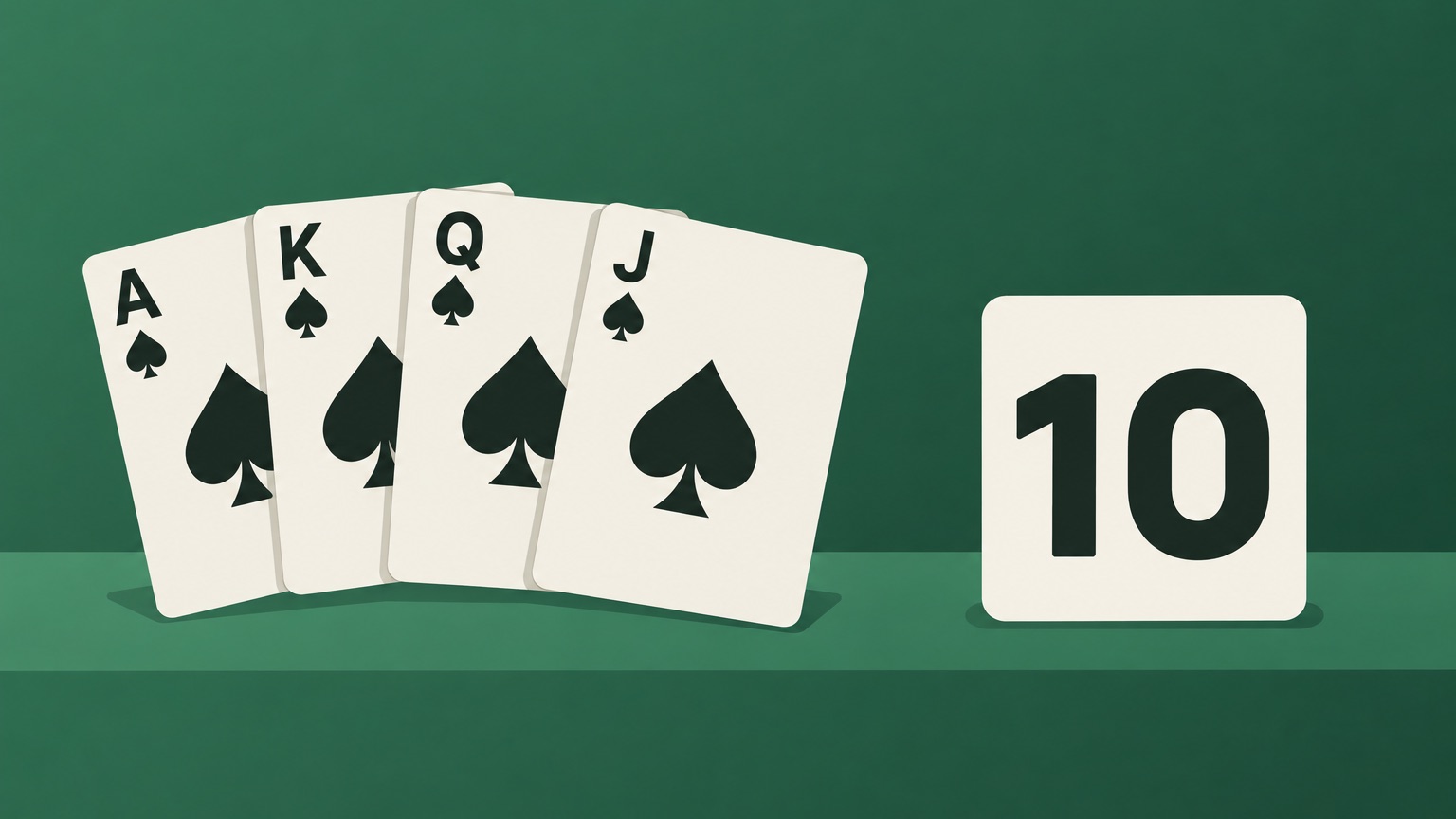
High-card points measure how good a hand is: 4 for an ace, 3 for a king, 2 for a queen and 1 for a jack. The deck holds 40, so 10 is an average hand, and about 12 or 13 is an opening hand. Add your points to partner's, and about 25 or 26 between you usually makes game in notrump or a major. Long suits are worth more than their high cards, so the shape of the hand counts too.
Counting your high-card points
Only the four top cards of each suit score, and tens and smaller cards count nothing. Add the points of every honor in your hand and you have its high-card points, often written HCP.
Count suit by suit, left to right, so you never miss a card. The scale is rough, since an ace usually takes a trick by itself while a jack rarely does, but it is quick and it works well enough to guide the bidding for most hands you will meet.
Forty points in the deck
Each suit holds 10 points, so the whole deck holds 40. Shared out evenly, that is 10 for each player. A hand with 10 points is average, a hand with 15 is good, and a hand with 20 or more is rare and very strong.
Because the total is fixed, your own count tells you something about the other three hands. If you hold 16, the other players share the remaining 24 between them, so partner is likely to hold about 8. As the auction goes on and players describe their hands, those guesses become much sharper.
A hand with about 12 or 13 points or more is called an opening hand. It is usually strong enough to make the first bid of the auction, called opening the bidding. Hands with fewer points usually pass at first, and the later lessons on bidding show the exceptions.
How many points does a partnership need?
Tricks come mostly from high cards, so the points held by you and partner together are a fair guide to how many tricks your side can take. Bridge rewards a side that bids high and makes it with large bonuses, which you will meet in the next lesson. The figures below show the totals that usually make those bonus contracts possible.
| Points between you | What your side can usually aim for |
|---|---|
| About 20 to 24 | A contract at a low level |
| About 25 or 26 | Game in notrump or a major. A game in a minor, eleven tricks, usually needs about 29 |
| About 33 | Small slam: 12 of the 13 tricks |
| About 37 | Grand slam: all 13 tricks |
The totals are only a rough guide. A side with 25 points and a long suit may take more tricks than a side with 27 points spread thinly. Still, the numbers explain why so much of the auction is spent finding out whether the two hands add up to 25 or 33.
A first look at shape
The shape of a hand, how many cards it holds in each suit, matters as well as its points. A long suit is worth more than its high cards suggest. Once the opponents have run out of that suit, its small cards become winners, so a 5 or a 6 can take a trick just like an ace. Many players add a point for each card beyond the fourth in a long suit to allow for this.
Shape is written as four numbers, the suit lengths from longest to shortest, such as 5-4-3-1. A hand with no void, no singleton (a suit of one card) and at most one doubleton (a suit of two) is called balanced. There are three balanced shapes, 4-3-3-3, 4-4-3-2 and 5-3-3-2. Balanced hands tend to suit notrump. Hands with a long suit and a short one usually want a trump suit, so the long suit can be set up and the short one ruffed.
The count to make every time
Pick up your hand, sort it, and add up the high-card points. Then look at the shape. Note any long suit and whether the hand is balanced. Those two facts, a number and a shape, are what you will describe to partner in the auction, and the sum of both hands tells your side how high to aim.
For more on judging a hand, see hand evaluation, and for the odds of holding a given number of points, see high card points.
Practice: counting points
Eight quick questions on what you just read.