 Conventions
Bergen Raises
Bergen raises are a set of jump responses to partner's 1♥ or 1♠ opening that promise four cards in the major and say at once how strong the raising hand is. Showing the fit at once helps the partnership judge how high to compete and whether to bid game. It also takes bidding room away from opponents who want to come into the auction.
How Bergen raises work
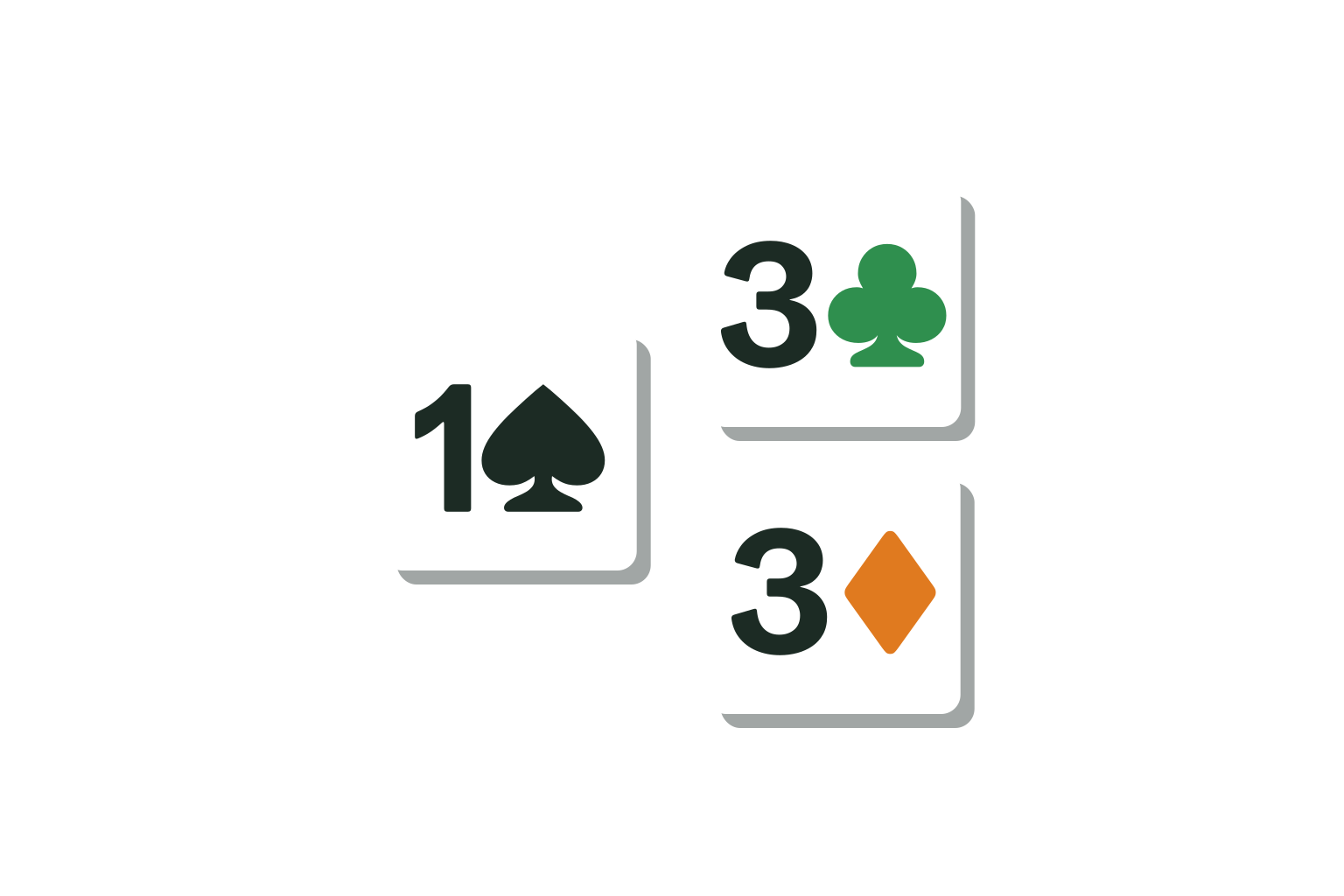
Marty Bergen developed these raises in the 1980s. Over 1♥ or 1♠, responder with four or more trumps chooses between three bids at the three level. Two of them are artificial club and diamond bids. The third is the direct raise, which becomes weak.
The structure over 1♥ is the same. The simple raise to two keeps its natural meaning but now promises exactly three trumps, so opener always knows the trump length. Game-forcing four-card raises go through Jacoby 2NT or a splinter bid.
| Points | Three trumps | Four or more trumps |
|---|---|---|
| 0-6 | Usually pass | 3M, preemptive |
| 6-10 | 2M | 3♣ from 7 points |
| 10-12 | 1NT forcing, then 3M | 3♦ |
| 13+ | New suit, then support | 2NT (Jacoby) or a splinter |
The Law of Total Tricks behind it
Four trumps opposite a five-card major make nine, enough under the Law of Total Tricks to bid for nine tricks at once. If the three-level contract fails, the opponents probably had a making part score of their own. If they bid on, they are a level higher than they would like.
So the weak four-card raise jumps straight to three of the major. A hand like ♠Q1074 ♥6 ♦J8752 ♣943 bids 3♠ over 1♠. The opponents now have to find their fit at the four level, with no room to exchange information. Opener, who knows the raise is weak, passes unless holding a strong hand.
Opener's rebids
After 3♣ or 3♦, opener knows the fit and the range, and the decision is usually simple.
After the constructive 3♣, opener's 3♦ asks whether responder holds the top or the bottom of the 7 to 10 range. Responder bids three of the major with a minimum and four with a maximum. Many partnerships play 3♦ as a help-suit try instead, showing length in diamonds, and responder then judges by the diamond holding as well as the points. Over 1♠ opener has more room, and by agreement 3♥ can serve as a second game try.
Example: a constructive raise
Had South held 7 or 8 points, South would have bid 3♥ over 3♦ and the partnership would have stopped safely at the three level. Opposite the 10 to 12 limit raise, 3♦, North would have accepted with 4♥ directly.
Reverse Bergen and other variations
Reverse Bergen swaps the two artificial bids: 3♣ becomes the limit raise and 3♦ the constructive raise. The stronger raise then gets the extra room, because after 3♣ opener still has 3♦ available as a game try or slam probe below three of the major. Agree with partner which version you play.
- After an overcall, Bergen raises are usually off. A cue bid of their suit shows a limit raise or better, and jump raises are preemptive. After a takeout double, partnerships differ. Some keep Bergen on, and others play 2NT (Jordan) as a limit raise or better, with jump raises preemptive.
- By a passed hand, Bergen raises are usually off, and many partnerships use Drury for passed-hand raises instead. A passed hand cannot hold a game force, so agree on what its jumps mean.
- Most Bergen players show a three-card limit raise of 10 to 12 points by bidding a forcing 1NT and then jumping to three of the major.
- The point ranges vary by about a point between partnerships. Bergen's original scheme used 6 to 10 for 3♣, 11 to 12 for 3♦ and 0 to 5 for the jump to three of the major. Some players call the 3♣ raise a mixed raise, since it is stronger than a preempt and weaker than a limit raise.
- Because Bergen raises use 3♣ and 3♦, natural jump shifts to those suits are lost. Larry Cohen, Bergen's former partner, does not recommend the convention, partly because of this.
Common mistakes
- Making a Bergen bid with three trumps. With only three, raise to two, or bid 1NT first when the hand is worth a limit raise.
- Treating 1♠ - 3♠ as a limit raise. The jump is preemptive, so opener passes unless holding a strong hand.
- Playing Bergen after an overcall. Most partnerships switch it off then and show a good raise with a cue bid of the overcalled suit. Over a double, it depends on your agreement.
- Playing Bergen over a minor opening. It applies only over 1♥ and 1♠. Over a minor, see inverted minors.
The Bergen raises tree
The tree below shows Bergen raises over both majors, with opener's rebids and every continuation. If you play reverse Bergen, swap the meanings of 3♣ and 3♦.
Loading the convention from the library.
Common questions
Short answers to what readers ask most.
- What are Bergen raises in bridge?
- They are jump responses to partner's 1♥ or 1♠ that promise at least four trumps. Responder bids 3♣ with 7 to 10 points, 3♦ with 10 to 12, and jumps straight to three of the major with a weak hand.
- Are Bergen raises alertable?
- Yes, the 3♣ and 3♦ responses are alertable. They are artificial bids that say nothing about clubs or diamonds, and in ACBL duplicate games and under most other regulations partner must alert them.
- What is reverse Bergen?
- Reverse Bergen swaps the two artificial bids: 3♣ shows the limit raise and 3♦ the constructive raise. The rest of the structure is the same.
- Are Bergen raises on after a double or an overcall?
- After an overcall they are usually off, and a cue bid of the opponents' suit shows a limit raise or better. After a double, partnerships differ. Some keep Bergen on, and others use 2NT to show a limit raise or better.
- What does a raise to two promise with Bergen?
- Exactly three trumps and about 6 to 10 points. With four trumps, responder uses one of the three-level Bergen bids.
- Why do Bergen raises go to the three level?
- They follow the Law of Total Tricks. When the two hands hold nine trumps between them, competing to the nine-trick level is usually safe, and bidding there at once makes it harder for the opponents to find their fit.
Practice: Bergen raises
Eight quick questions on what you just read. For a longer session, bid a hundred hands or take the hundred-question quiz.