Scoring
Bridge IMP Table
In a teams match, the two results on each board are compared and the difference is converted into IMPs, short for International Match Points, using a fixed scale. Small differences count for little and large ones count for more, though not in proportion to their size. Knowing the scale tells you which risks are worth taking at teams.
IMP conversion table
| Difference | IMPs | Difference | IMPs |
|---|---|---|---|
| 0 to 19 | 0 | 750 to 899 | 13 |
| 20 to 49 | 1 | 900 to 1099 | 14 |
| 50 to 89 | 2 | 1100 to 1299 | 15 |
| 90 to 129 | 3 | 1300 to 1499 | 16 |
| 130 to 169 | 4 | 1500 to 1749 | 17 |
| 170 to 219 | 5 | 1750 to 1999 | 18 |
| 220 to 269 | 6 | 2000 to 2249 | 19 |
| 270 to 319 | 7 | 2250 to 2499 | 20 |
| 320 to 369 | 8 | 2500 to 2999 | 21 |
| 370 to 429 | 9 | 3000 to 3499 | 22 |
| 430 to 499 | 10 | 3500 to 3999 | 23 |
| 500 to 599 | 11 | 4000+ | 24 |
| 600 to 749 | 12 |
How a teams match is scored
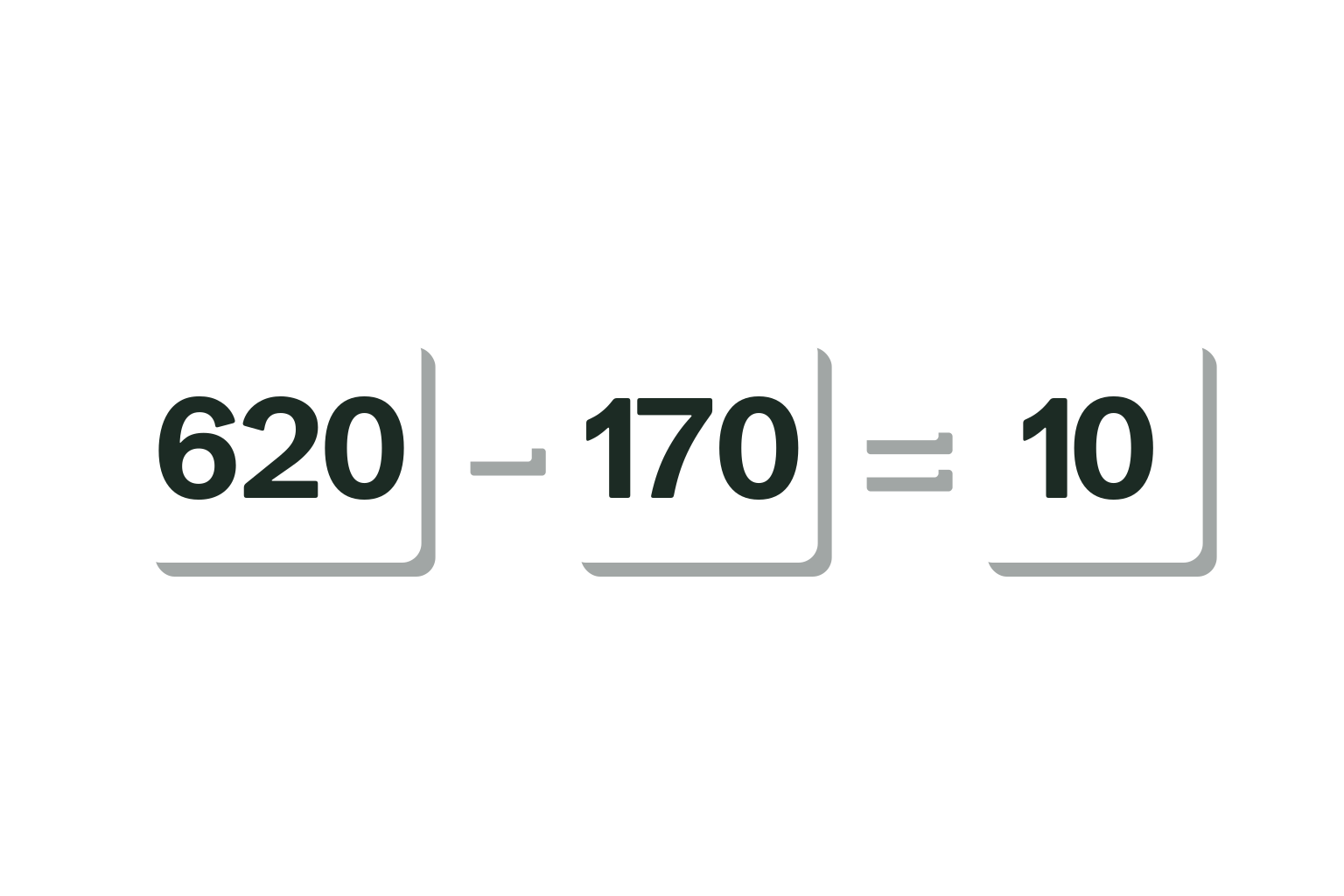
Every board is played twice. Your pair sits North-South at one table and your teammates sit East-West at the other, so your team holds both sides of the same cards. On each board you add the two results and convert the net figure into IMPs. Say you bid 4♠ vulnerable and make it for +620, while at the other table the opponents stop in a part score and make ten tricks for 170. Your team is +450 on the board, which the table turns into 10 IMPs.
An overtrick barely matters. If you make an overtrick in 4♠ and your counterpart does not, the 30 points are worth 1 IMP.
Why the scale flattens
The bands widen as the scores grow. At the bottom a gap of 20 to 40 points is 1 IMP and 50 to 80 is 2. Further up, 1500 to 1740 is 17 and anything from 4000 is capped at 24. So even a very large penalty gains at most 24 IMPs, and in a long match one bad board can often be won back.
The staircase climbs fast and then flattens. The first 100 points are worth 3 IMPs, the first 500 are worth 11, and a thousand only 14. Every swing a vulnerable game or slam makes lands on the flat part, which is why they all score in the same double figures.
The cheap IMPs are the small ones: the first costs 20 points, the fifth 40, the twelfth 100, and from the twenty-second each one costs 500 points. So an overtrick or a part-score decision moves the score by more per point than a slam does, and a run of small gains adds up to a game swing.
The shape also changes how people bid. Against a pair that stops short and takes the same tricks, a vulnerable game or a slam gains 10 IMPs or more, and a non-vulnerable game gains 6. Overtricks and part-score battles rarely move the match much. Most teams players stretch for a vulnerable game and play safely for their contract instead of chasing the extra trick. The game and slam odds are worked straight from this table, and the scoring guide compares IMPs with matchpoints. To get the raw scores for any board, use the scoring calculator or the scoring table.
Common questions
Short answers to what readers ask most.
- What is an IMP in bridge?
- An IMP, or International Match Point, is the unit teams matches are scored in, and some pairs events use it too. The point difference on each board is converted to IMPs on a fixed scale running from 0 to 24.
- What is the maximum number of IMPs on one board?
- 24 IMPs, for a difference of 4000 points or more. The scale stops there however large the swing.
- How many IMPs is a missed vulnerable game?
- Usually 10. Bidding and making 4♠ vulnerable scores 620, and stopping in a part score with ten tricks scores 170, a difference of 450.
- What is the difference between IMPs and matchpoints?
- At IMPs the size of the swing matters, so a missed game costs far more than a lost overtrick. At matchpoints each board is ranked against the other tables, and an overtrick can be worth as much as a game.
Practice: the IMP table
Eight quick questions on what you just read. For a longer session, take the hundred-question quiz.