Help suit game tries
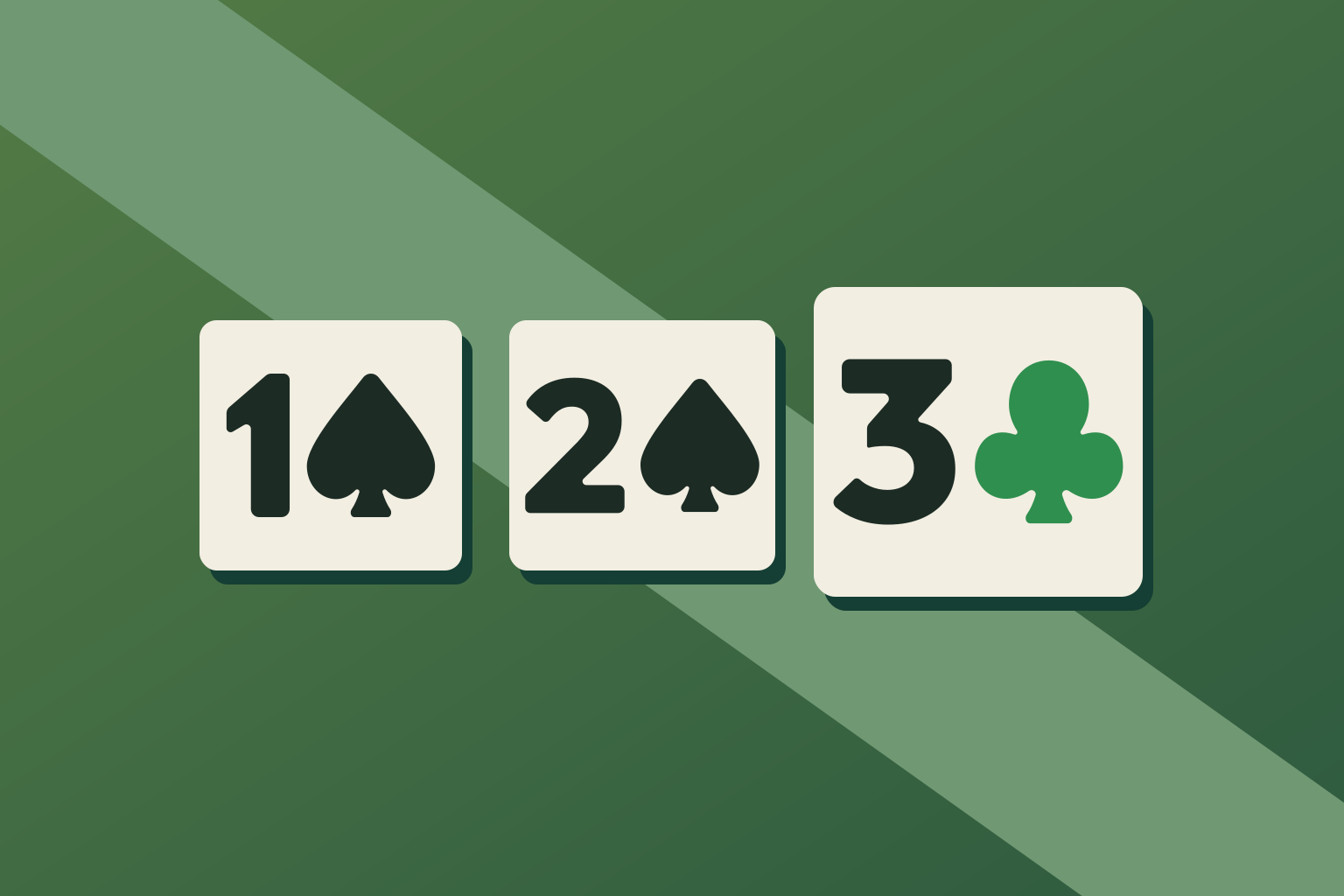
A help suit game try is a new suit bid by opener after a single raise of a major, as in 1♠ - 2♠ - 3♣: it invites game and asks partner to bid game with high cards or shortness in that suit, and to sign off in three of the major without them.
Updated 14 October 2026
Sixteen points opposite a single raise of a major is the awkward middle. Partner's 6 to 10 points may give you an easy game or leave you a trick short, and the point count alone cannot say which. A help suit game try is the bid that decides it. After 1♥ - 2♥ or 1♠ - 2♠, opener bids a new suit to say "I am interested in game, and this is the suit where I need help". Responder bids game holding high cards or shortness in that suit, and signs off in three of the major without them.
It works because the location of partner's values matters more than their number. A king in the suit where you hold three small cards is worth a trick. The same king in a suit where you hold the ace and queen adds very little.
How a help suit game try works
The auction starts with a five-card major and a simple raise. Opener, holding more than a minimum but less than a sure game, bids the side suit with the most losers. The bid is forcing for one round and says nothing about length beyond three or more cards. Responder looks at that suit only, then at the overall strength of the raise, and chooses between game and three of the major.
Over 1♥ - 2♥ opener has three tries, 2♠, 3♣ and 3♦. Over 1♠ - 2♠ there are also three, 3♣, 3♦ and 3♥, all at the three level. In both auctions the try suit is the only new information, so responder never has to guess what opener is worried about.
When opener makes a game try
A simple raise shows 6 to 10 points. Opener needs about 26 between the hands for game in a major, so a game try is for the hands that reach game only opposite the right half of that range. Count high-card points plus a point for each card over four in a suit, or count losers.
| Opener's hand | Points | Losers | Rebid |
|---|---|---|---|
| Minimum | 12 to 15 | 7 or more | Pass |
| Invitational | 16 to 18 | 6 | A game try |
| Game values | 19 or more | 5 or fewer | Game in the major |
The two columns usually agree, and the loser column is the one to trust when they do not. The losing trick count treats a single raise as 9 losers. Six opposite nine gives 24 - 15 = 9 tricks, which is exactly the invitational case. Five losers opposite nine gives ten tricks, enough to bid game without asking. A hand with seven losers expects eight tricks and passes, whatever its point count.
Choosing the try suit
Bid the side suit where partner's help is worth most. That is a suit of three or more cards with two or three losers: xxx, Jxx, Qxx, Kxx or Axx, or four cards headed by one of those honors. Partner's king, queen or shortness there turns a loser into a winner, and the try names it.
- Not a strong suit. AKx or AQx has one loser at most. Partner's help there is wasted, so asking about it misleads.
- Not a doubleton or singleton. A doubleton has at most two losers and a singleton one, and partner's shortness there would only duplicate yours.
- Two weak suits. Choose the one with more losers. Holding xxx and Kxx, ask about the xxx.
- Two equal suits. Bid the cheaper one. That leaves partner the most room, including room for a counter-try.
Take ♠AKJ85 ♥K4 ♦AQ6 ♣742 after 1♠ - 2♠. The spades are solid enough, the ♥K4 costs one loser at most, and the ♦AQ6 has one loser. The clubs are three straight losers. Bid 3♣. If partner holds the ♣K, a club singleton or a void, game is likely; if partner holds three small clubs, it is not.
How responder answers a help suit game try
Responder counts losers in the try suit first, then looks at the whole hand. Count only the first three cards of the suit. In three or more cards each ace, king or queen covers a loser. In a doubleton only the ace and king count, a singleton is one loser unless it is the ace, and a void is none. Shortness counts because responder's trumps can ruff opener's third and fourth cards in the suit.
| Holding in the try suit | Losers | Minimum (6 or 7) | Maximum (8 to 10) |
|---|---|---|---|
| Void, singleton, Ax, Kx, AKx, AQx, KQx | 0 or 1 | Game | Game |
| Axx, Kxx, Qxx, Qx, xx | 2 | Three of the major, or a counter-try | Game |
| xxx, Jxx, xxxx, Jxxx | 3 | Three of the major | Three of the major |
Good help accepts even with 6 points, because those few points are in the right place. Three losers in the try suit decline even with 9, because opener has just said that the trouble is there and your values are elsewhere. A few players accept on a 10-count that nearly made a limit raise. The two-loser row calls for judgment. Many players stretch to accept with Axx or Kxx at the lower end of the range, since a top honor is a sure trick and a doubleton needs trumps to spare. A fourth trump counts as a plus in every row.
Answering never means passing. The try is forcing for one round, so the choice is between three of the major, game, and occasionally a counter-try.
Counter-tries
When there is room between the try suit and three of the major, responder in the middle row can bid another suit to show values there. After 1♥ - 2♥ - 3♣, responder's 3♦ says "clubs are not great, but I have something in diamonds". Opener, who knows where the two hands fit, makes the final decision. After 1♠ - 2♠ - 3♦, the counter-try is 3♥. Over a 3♦ try in hearts there is no room, and responder simply chooses.
Help suit game try examples
The same opening hand, two different partners. North opens 1♠ with 15 high-card points and six losers, and South raises. North's worst suit is diamonds, three small, so North bids 3♦ both times.
South held more points on the second deal and still made the right decision to stop. A raise to game on points alone would have reached the losing game and missed the winning one.
Other game tries and variations
Help suit tries are the default in Standard American and most club partnerships, but they are not the only way to invite after a single raise.
- The re-raise. 1♠ - 2♠ - 3♠ is a general invitation, asking responder to bid game with a maximum. Some pairs read it as asking about trump quality, and in competition it is only an effort to buy the contract.
- 2NT. In standard methods it invites game with a balanced hand and offers 3NT as an alternative. Pairs who play two-way game tries use it as a relay instead.
- Short suit game tries. The opposite idea: opener bids a singleton or void, and responder accepts with few wasted honors opposite it. Some pairs combine both, with 2NT as the relay to short-suit tries.
- Long suit game tries. An older version that promises four or more cards in the try suit, partly to find a second fit. Most players now prefer the help suit version.
- After a limit raise. Over 1♠ - 3♠ a new suit is a slam try, since game is already reached. See splinter bids and cue bids.
- In competition. If the opponents bid up to three of your major, there may be no room for a try. The maximal double fills that gap.
The same tries work after responder's major is raised, as in 1♦ - 1♠ - 2♠, where responder becomes the one who asks.
Common mistakes
- Trying in your best side suit. A try asks where you need help. Bidding AKx because it is a "real" suit tells partner the wrong thing.
- Counting points instead of the suit. Responder with 9 points and xxx in the try suit should sign off. Responder with 6 points and a singleton should accept.
- Passing the try. A new suit by opener after a raise is forcing. Responder must bid three of the major at least.
- Making a try with a game hand. With 19 points or five losers, bid game. Every try gives the defenders a lead.
- Forgetting the defenders are listening. A declined try points them at opener's weak suit. That is one reason to bid game directly when it is clear, and to keep tries for the real borderline hands.
In the Bidding Architect
This is the help suit game try structure as it sits in the Bidding Architect's convention library, with the tries over 1♥ and 1♠, the sign-offs, the acceptances and the counter-tries. Copy it into your own system and drill it in practice mode.
Loading the convention from the library.
Common questions
Short answers to what readers ask most.
- What is a help suit game try in bridge?
- A help suit game try is a new suit bid by opener after a single raise of a major, as in 1♠ - 2♠ - 3♣. It invites game and asks partner for help in that suit. Partner bids game with high cards or shortness there and signs off in three of the major without them.
- How many points do you need for a help suit game try?
- About 16 to 18 points counting length, or six losers. With 15 or fewer opener passes the raise, and with 19 or more opener bids game.
- What counts as help for a game try?
- Help is a holding that saves opener a loser in the try suit: the ace or king, a singleton or void, and with a maximum also a doubleton or the queen. Three or more small cards, or a jack with small cards, are no help.
- Is a help suit game try forcing?
- Yes, it is forcing for one round. Responder must bid at least three of the agreed major, and bids game with help.
- What is the difference between a help suit and a short suit game try?
- A help suit try names opener's weak suit and asks for honors or shortness there. A short suit try names opener's singleton or void and asks responder to have few wasted honors in it. Partnerships play one or the other, or both with a relay.
- Does a help suit game try apply after 1♠ - 2♠ - 3♥?
- By default, yes. 3♥ asks for help in hearts. Some partnerships play it as a natural bid showing four or more hearts, to find a 4-4 heart fit, so it is worth agreeing which.
Practice: help suit game tries
Eight quick questions on what you just read. For a longer session, bid a hundred hands or take the hundred-question quiz.