The Maximal Double
A maximal double is a game try made with a double: after your side bids and raises a major and the opponents compete at the three level in the suit directly below it, opener doubles to invite game, and 3 of the major only competes.
Updated 14 October 2026
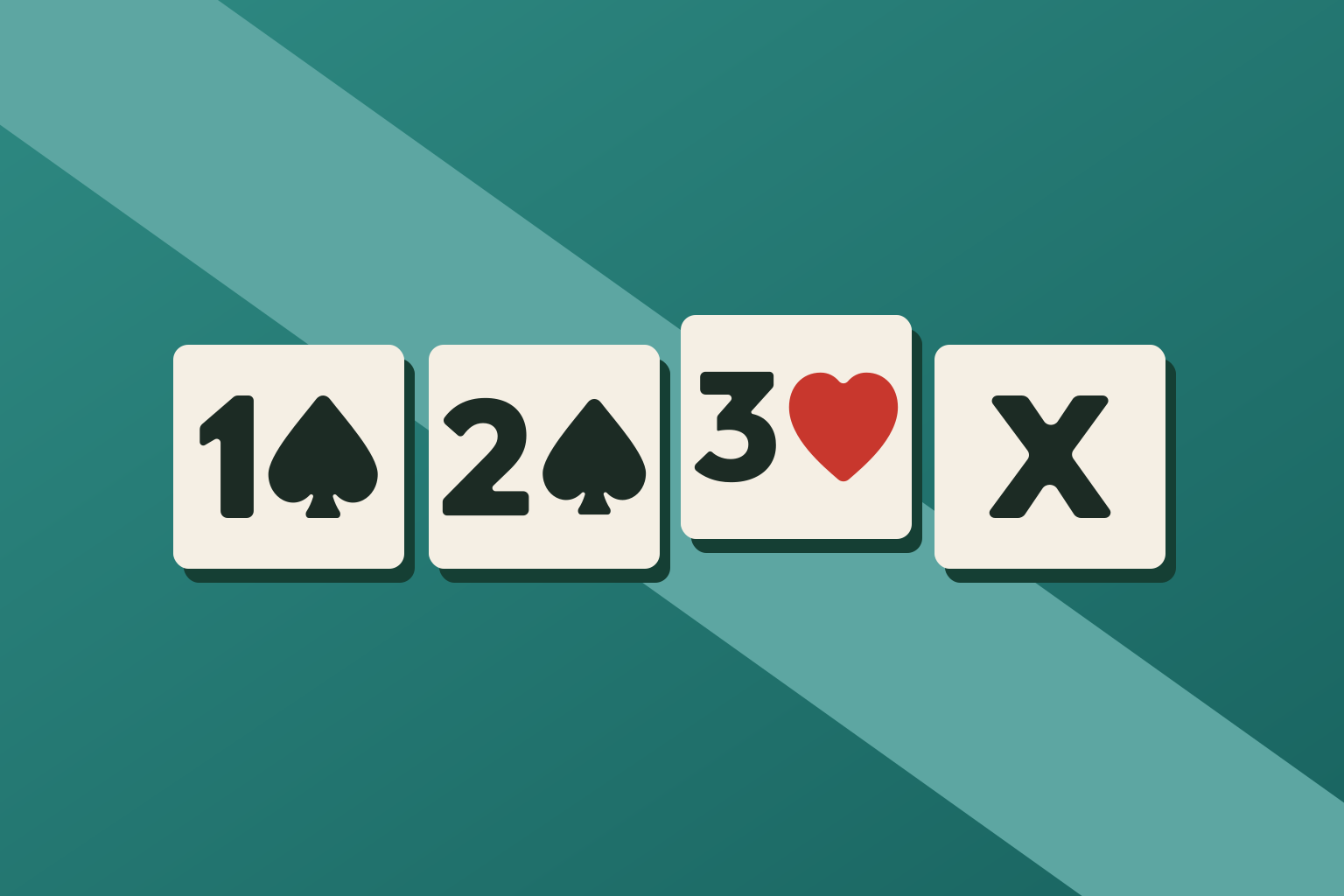
The maximal double is a game try made with a double. You open 1♠, partner raises to 2♠, and the opponents bid and raise hearts to 3♥. Every bid between 2♠ and 3♠ has gone, so opener has no room left for a help suit game try. Playing maximal doubles, opener doubles to invite game and bids 3♠ only to compete. Partner then knows which one it is.
How the maximal double works
The double applies when your side has bid and raised a major and the opponents compete at the three level in the suit directly below it. For hearts that suit is diamonds, and for spades it is hearts. In those two auctions the double is artificial. It says nothing about the opponents' suit and asks partner whether the raise was a minimum or a maximum.
The same structure works for hearts. After 1♥ - (2♦) - 2♥ - (3♦), opener's double is the game try and 3♥ is a sign that opener only wants to outbid them.
| Auction | Opener's double | Opener's 3 of the major |
|---|---|---|
| 1♥ - (2♦) - 2♥ - (3♦) | Game try in hearts | Competing, no game interest |
| 1♠ - (2♥) - 2♠ - (3♥) | Game try in spades | Competing, no game interest |
Why a double is the only game try left
Without competition, 1♠ - 2♠ leaves opener plenty of room. 2NT, 3♣, 3♦ and 3♥ can all be game tries, and 3♠ is a plain invitation. Once the opponents bid 3♥, the only call left below 3♠ is a double. If the double were for penalty, 3♠ would have to cover two very different hands.
- A minimum opener with a sixth spade who wants to push the opponents up a level, or buy the contract at 3♠.
- A good hand of about 15 to 17 points that would have made a game try if the opponents had kept quiet.
Partner cannot tell these apart, and they call for opposite answers. Over the first hand partner should pass 3♠ even with a maximum raise. Over the second, a maximum raise should bid game. Maximal doubles give each hand its own call. The price is the penalty double of 3♥ or 3♦, and at this level a doubled partscore is rarely where the big swings come from.
When a double is maximal and when it is penalty
The double is maximal only when the opponents' suit takes away all your room. If their suit sits lower, a cheaper new suit is still available as a game try, so the double keeps its penalty meaning in the standard version.
| Auction | Double means | Opener's game try instead |
|---|---|---|
| 1♠ - (2♥) - 2♠ - (3♥) | Maximal: a game try | None left, the double is the try |
| 1♥ - (2♦) - 2♥ - (3♦) | Maximal: a game try | None left, the double is the try |
| 1♠ - (2♦) - 2♠ - (3♦) | Penalty | 3♥, a help suit try |
| 1♠ - (2♣) - 2♠ - (3♣) | Penalty | 3♦ or 3♥ |
| 1♥ - (2♣) - 2♥ - (3♣) | Penalty | 3♦ |
| 1♥ - (1♠) - 2♥ - (2♠) | Penalty | 2NT, 3♣ or 3♦ |
Some partnerships go further and play every double of a raised suit at this point as a game try, keeping the new suits for other purposes. Others do the opposite and keep the double for penalty everywhere. Both are playable. The version in the table is the usual one, and it needs no extra discussion beyond the two auctions above.
The double also needs an agreed major. After 1♥ - (2♦) - 2♠ - (3♦), partner has bid a new suit and not raised, so a double is either for penalty or, for pairs who play them at this level, a support double.
After an overcall
The idea carries over when your side overcalls in a major and partner raises. After (1♣) - 1♠ - (2♥) - 2♠ - (3♥), the overcaller's double is the game try and 3♠ competes. Many pairs also use it when the opponents jump straight to the three level, as in 1♠ - (Pass) - 2♠ - (3♥), since the room problem is the same.
Choosing between the double, 3 of the major and pass
Opener's choice depends on strength and on trump length. A simple raise usually holds three or four trumps, so five opposite three gives an eight-card fit and six opposite three gives nine. The law of total tricks says to compete to the level that matches your trumps, eight trumps for the two level and nine for the three level.
| Opener holds | Call | Why |
|---|---|---|
| 12 to 14 points, five trumps | Pass | Eight trumps is usually not enough to bid at the three level |
| 12 to 14 points, six trumps | 3 of the major | Nine trumps, so compete, with no game interest |
| About 15 to 17 points | X | The game try, partner decides |
| About 18 points or more | 4 of the major | Game opposite even a minimum raise |
Passing a minimum does not end the auction for your side. Partner, holding a four-card raise, can still compete with 3 of the major over the pass. The guide numbers are a starting point. A hand of 14 with a good second suit and a singleton plays like more and can try for game, while a flat 15 with soft honors in their suit can pass or compete quietly.
Responder's answer
Over the double, partner bids game with the top of the raise, about 8 or 9 points or a fourth trump with good shape, and signs off at 3 of the major with a minimum. Some partnerships also let responder pass the double with a strong holding in the opponents' suit and a maximum, converting it to penalty. That should be agreed, since the default is to answer the game try. When opener has bid 3 of the major instead of doubling, responder passes even with a maximum, because opener has already said there is no game.
Example deals
You can deal more hands like these in the simulator, or check how many tricks each side takes in the double dummy solver.
Common mistakes
- Bidding 3 of the major with a good hand. In this auction 3♠ is a sign-off. A hand that wants partner to bid game must double.
- Raising after opener competes. Responder passes opener's 3 of the major, however good the raise. Opener chose not to try for game.
- Doubling when room remains. After 1♠ - (2♣) - 2♠ - (3♣), 3♦ and 3♥ are still available as tries, so the double is for penalty in the standard version.
- Doubling without a fit. The double needs a bid and raised major. If partner bid a new suit instead, it means something else.
- Competing on eight trumps. A minimum with five trumps opposite a three-card raise should usually pass and let partner decide, rather than bid to the three level alone.
Maximal doubles sit comfortably beside negative doubles and responsive doubles, since all of them treat low doubles in competitive auctions as constructive. Mark it on your convention card and expect the opponents to ask what it means, because without an agreement a double of their raise looks like penalty.
In the Bidding Architect
The library entry holds both maximal double auctions, 1♥ - (2♦) - 2♥ - (3♦) and 1♠ - (2♥) - 2♠ - (3♥), with opener's competitive 3 of the major and responder's answers to the double. Copy it into your system and drill it in practice mode.
Loading the convention from the library.
Common questions
Short answers to what readers ask most.
- What is a maximal double in bridge?
- A maximal double is a game try made with a double. After your side bids and raises a major and the opponents compete in the suit directly below it at the three level, opener's double invites game and 3 of the major only competes.
- When does a maximal double apply?
- In the standard version, after 1♥ - (2♦) - 2♥ - (3♦) and 1♠ - (2♥) - 2♠ - (3♥), and the same auctions after your side overcalls. If the opponents' suit is lower, a new suit is still available as a game try and the double is for penalty.
- How many points do you need for a maximal double?
- About 15 to 17 points, the range of an ordinary game try opposite a simple raise. With about 18 or more, bid game directly.
- What does 3 of the major mean if you play maximal doubles?
- It is purely competitive. Opener has a minimum, usually with a sixth trump, and wants to outbid the opponents, so partner passes even with a maximum raise.
- Can partner pass a maximal double?
- Only if the partnership has agreed it. By default partner answers the game try, bidding 3 of the major with a minimum and game with a maximum. Some pairs let responder pass with a strong holding in the opponents' suit.
Practice: maximal doubles
Eight quick questions on what you just read. For a longer session, bid a hundred hands or take the hundred-question quiz.