The law of total tricks
The law of total tricks says that the tricks both sides can take, each in its best trump fit, add up to about the total number of trumps the two sides hold, so in a competitive auction you can bid to the level of your own side's trumps.
Updated 14 October 2026
Jean-René Vernes, a French expert, noticed that competitive part-score deals followed a pattern. Add the tricks one side can take in its trump suit to the tricks the other side can take in theirs, and the total comes out close to the number of trumps the two sides hold between them. He published it in English in The Bridge World in June 1969. Larry Cohen turned it into a bidding rule in To Bid or Not to Bid (1992), and today it is the reason club players raise a weak two to the three level with three trumps.
The law and the rule you bid by
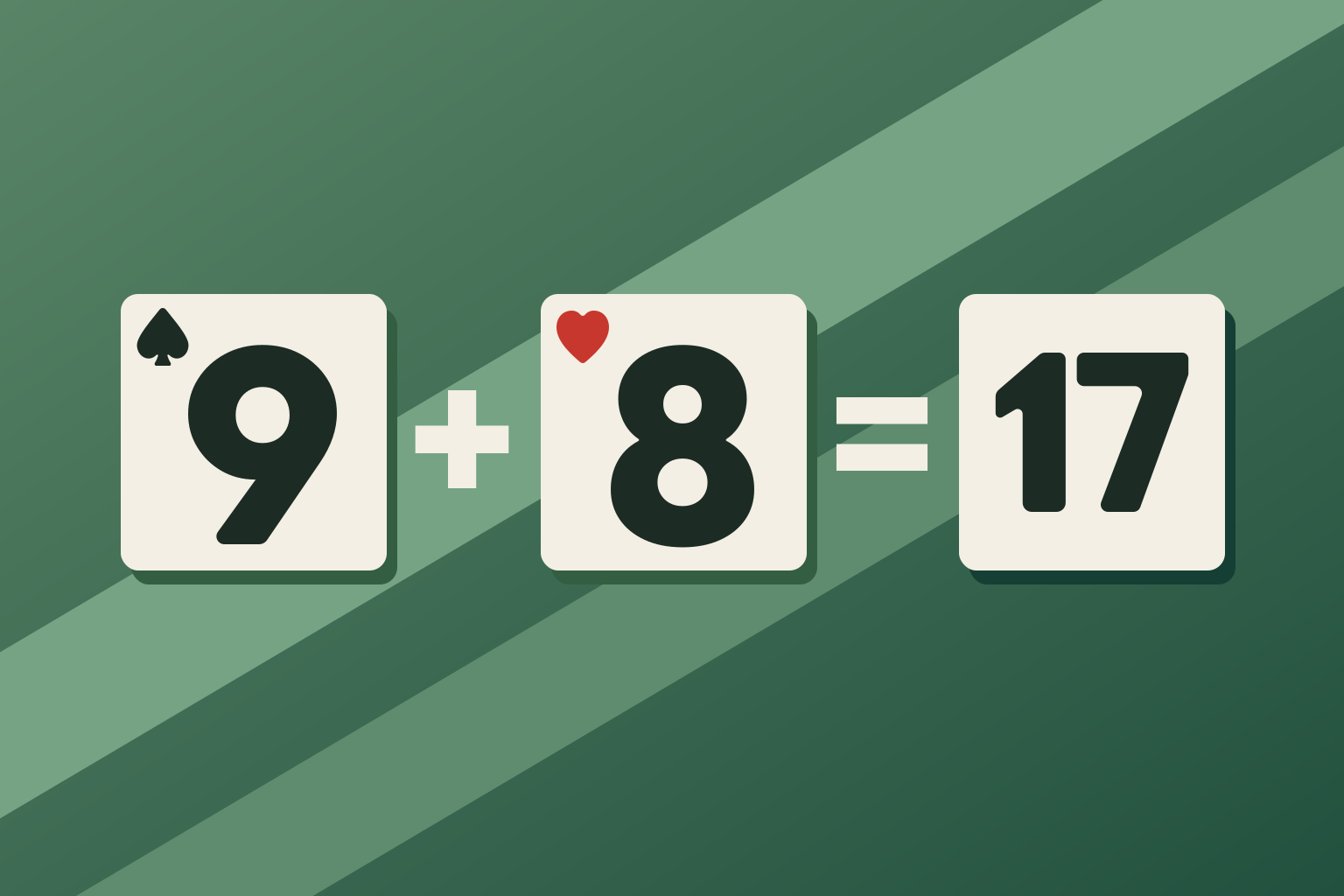
Total tricks is the number of tricks your side can take playing in its best trump fit plus the number the opponents can take playing in theirs. Total trumps is your side's trumps in that fit plus their trumps in theirs. The law says the two numbers are about equal. If your side holds nine spades and they hold eight hearts, there are 17 total trumps, and the law expects 17 total tricks: 9 for you and 8 for them, or 10 and 7, or 8 and 9.
Cohen's working rule follows from it. In a competitive auction, bid to the level of your side's trumps. Contract for as many tricks as you hold trumps, and no more.
| Your side's trumps | Compete to | Tricks you contract for |
|---|---|---|
| 8 | The two level | 8 |
| 9 | The three level | 9 |
| 10 | The four level | 10 |
| 11 | The five level, with care | 11 |
Why is this safe? Take the 17-trump deal above. If you bid 3♠ with your nine spades and go down one, you took 8 tricks, so the law gives the opponents 9 in hearts. Not vulnerable, your 3♠ down one costs 50 points, and they would have scored 140 playing in hearts. Vulnerable, down one costs 100, still less than their 140. Either you make your contract or you lose less than their part score was worth. The exception is being doubled when vulnerable. 3♠ doubled down one vulnerable is 200, more than any part score they could make.
Going beyond the safety level is a different bet. If you hold eight trumps and they hold eight, there are 16 tricks to share, and the side that buys the contract at the three level usually goes down. Cohen's short version is that with only eight trumps you should not bid three over their three.
Counting the trumps during the auction
You know your own hand, and partner's bids tell you a minimum length. Add the two and you have your side's trumps. These are the usual promises in Standard American; check them against your own agreements.
| Partner's bid | Length shown |
|---|---|
| Opens 1♥ or 1♠ | 5+ |
| Overcalls at the one or two level | 5+ |
| Opens a weak two | 6 |
| Opens at the three level | 7 |
| Raises your suit | 3+ |
| Makes a takeout double | Usually 3+ in each unbid suit |
The opponents' trumps are a guess from their auction. If one of them bids a suit and the other raises, place them with at least eight. When your side holds few cards in their suit, they likely hold more: if you and partner have four hearts between you, the opponents have nine.
Counting your own side is the part that wins points, and it decides the raise. Holding four-card support for partner's five-card major, you have nine trumps, so a weak raise goes straight to the three level. That is the idea behind Bergen raises and the weak jump raise in competition. Holding three cards opposite a weak two, you have nine trumps again, and the raise to three is a preempt and partner passes it.
A deal: the three level belongs to nobody
Neither side is vulnerable. North opens 1♠, East overcalls 2♥, South raises to 2♠ and West competes with 3♥. North holds 14 points and wonders about 3♠.
South's simple raise promised three spades, so North knows the side has eight trumps, and West's raise suggests the opponents have eight hearts. The law expects 16 tricks. Double dummy, North-South take exactly 8 tricks in spades and East-West exactly 8 in hearts. 3♥ goes down one for +50 to North-South. Had North bid 3♠, it would also go down one, for -50. Passing is worth 100 points on this deal.
West's 3♥ was itself a bid above the law's level, and it happened to work. If West had passed, 2♠ would have made for 110 to North-South, so going down 50 in 3♥ saved 60. On this 16-trick deal both three-level contracts fail, so whichever side bids last at the three level loses.
A deal: raise to the level of your trumps
Neither side is vulnerable. North opens 1♠ and East overcalls 2♥. South has only 6 points but four spades, which makes nine trumps.
Double dummy, North-South take 9 tricks in spades and East-West take 8 in hearts, so the law is exactly right here. 3♠ makes for +140. The jump also did its second job. West, with 9 points and three hearts, might have competed with 3♥ over a quiet 2♠, but over 3♠ there is no room left below the four level, and the law gives East-West no reason to go there with eight trumps.
How accurate is the law?
We solved 10,000 random deals double dummy, put each side in its longest fit, and compared total tricks with total trumps. The law was exactly right on 39.6% of deals and within one trick on 87.0%. It missed by two or more on 13.0%. Those figures barely moved when we kept only the deals where the high-card points were split close to evenly, the competitive part-score deals the law was written for.
| Total trumps | Deals | Exactly right | Within one trick | Tricks minus trumps, average |
|---|---|---|---|---|
| 14 | 1,072 | 49.6% | 93.4% | +0.41 |
| 15 | 1,013 | 46.1% | 92.9% | +0.33 |
| 16 | 2,757 | 41.7% | 88.1% | +0.15 |
| 17 | 2,271 | 38.7% | 88.5% | +0.13 |
| 18 | 1,544 | 33.8% | 84.5% | +0.01 |
| 19 | 825 | 30.8% | 77.8% | -0.17 |
| 20 | 366 | 33.9% | 77.6% | -0.38 |
The pattern in the last column is the useful part. On deals with few total trumps there tend to be slightly more tricks than trumps, and on deals with many there tend to be fewer. The law is a good estimate, not an exact count, and the adjustments below are how strong players decide which way a given deal leans.
Adjustments: when to bid more or less
Cohen and later writers list the features that push the trick count above or below the trump count. They are judgment calls. Most players treat each as worth about half a trick to a trick.
- A double fit adds tricks. When your side also has a second eight-card or longer fit, the long side suit runs and the trick total often beats the trump total by one or two.
- Flat shape costs tricks. If your hand is 4-3-3-3, nothing ruffs and no long suit sets up. Count one trick less, and two flat hands opposite each other are worse.
- Soft honors in their suit cost tricks. Queens and jacks in the opponents' trump suit, such as Qx or QJx, are worth something in defense but little when you declare, and they suggest the deal will produce fewer total tricks.
- Honors in your own long suits add tricks. Kings and queens that fill out your trumps and side suit carry their full value whoever declares.
- Trump spots matter at the edges. A suit like AJ1098 loses fewer tricks than A7542, and good intermediates make the higher number more likely.
Here is a deal where everything points down. Every hand is balanced, and South's Q93 in hearts sits in the opponents' suit.
A North-South pair who followed the bare law to 3♠ with their nine trumps would go down one. An adjusted count of one trick less, for the flat South hand with heart values, keeps them at 2♠, which makes.
The double fit works the other way. On the deal below North-South have nine spades and ten diamonds, East-West ten hearts and nine clubs.
North-South make 11 tricks in spades, East-West make 10 in hearts. Both sides have a second fit and short suits to ruff with, and the total runs two tricks above the trumps. If East-West bid 4♥, North-South do best to bid 4♠, which makes with an overtrick for 450 not vulnerable, rather than defend against a making 4♥ worth 420 to the opponents.
Where the law does not help
- Game and slam decisions. When your side holds most of the high cards, the question is whether game makes, and that turns on points and fit. Total trumps do not answer it. The law is a tool for deals where both sides can compete.
- Notrump. The law counts trump contracts. It says nothing about 3NT.
- Unknown lengths. If you cannot tell how many trumps the opponents hold, the total is a guess and the law is only half used. Your own side's count, which you usually do know, is the half that sets your bidding level.
- Vulnerability and doubles. The law estimates tricks and leaves the scoring to you. Bidding to the level of your trumps is safe in the sense that you lose less than their part score, but vulnerable and doubled, down one is 200 and down two is 500.
- The five level. Eleven trumps permit the five level by the law, but a five-level save that turns out wrong is expensive, and experienced players bid it less often than the bare count suggests.
The law also has its critics. Mike Lawrence and Anders Wirgren argued in I Fought the Law of Total Tricks (2004) that the law is less accurate than its followers believe, and proposed counting short suits instead. Their counts are harder to use at the table, and most club players keep the law as the starting estimate and adjust from there.
Common mistakes
- 1.Counting partner for more trumps than promised. A raise shows three. Unless the bidding has shown a fourth, do not count it.
- 2.Bidding three over three with eight trumps. On a 16-trump deal both sides usually go down at the three level, so let them play there.
- 3.Using the law to bid games. Raising a weak two to game with four trumps is a preempt. It is not a game try, and partner must not treat it as one.
- 4.Forgetting the adjustments. Two flat hands with queens in the opponents' suit will rarely produce the full total. Shade the count down.
- 5.Ignoring the score. Vulnerable against not vulnerable, the doubled penalty for going down can exceed the part score you were trying to stop.
Common questions
Short answers to what readers ask most.
- What is the law of total tricks in bridge?
- The law of total tricks says that the number of tricks both sides can take, each playing in its best trump fit, is about equal to the total number of trumps the two sides hold. Its practical rule is to compete to the level of your own side's trumps: eight trumps to the two level, nine to the three level, ten to the four level.
- Who invented the law of total tricks?
- Jean-René Vernes, a French player and writer, described it and published it in The Bridge World in 1969. Larry Cohen made it popular with his books To Bid or Not to Bid (1992) and Following the Law (1994).
- How accurate is the law of total tricks?
- It is an estimate. On 10,000 random deals we solved double dummy, it was exactly right on about 40% of them and within one trick on 87%. It tends to count low on deals with few trumps and high on deals with many.
- Does the law of total tricks apply to notrump?
- No. The law counts tricks in trump contracts, and both sides' trumps are part of the count. It is a guide for competitive suit auctions.
- How do I count the opponents' trumps?
- Use their auction. A suit bid and raised usually means at least eight cards. Then take your side's length in that suit into account: the fewer you and partner hold, the more they have.
- Should I always bid to the level of my trumps?
- No. It is a safety level for competitive auctions, not a target. Adjust down for flat hands and honors in the opponents' suit, adjust up for a double fit, and take care when vulnerable, where a doubled down one costs 200.
Practice: the law of total tricks
Eight quick questions on what you just read. For a longer session, take the hundred-question quiz.