Bridge Hand Generator
A free bridge hand generator that deals random boards straight in your browser, with no sign-up, and lets you set points and shape for any seat.
Updated 14 October 2026
Every visit to this page starts with a fresh board, shuffled in your browser the moment it loads. Press Deal again for the next one, or pick a number of boards to deal a whole set at once, up to 32. The generator is free, needs no account and sends nothing to a server. The deals stay on your device until you copy, download or print them.
Conditions apply from the next deal.
Free, no sign-up, dealt in your browser. For thousands of deals with double dummy results, use the Bridge Lab simulator.
How to use the hand generator
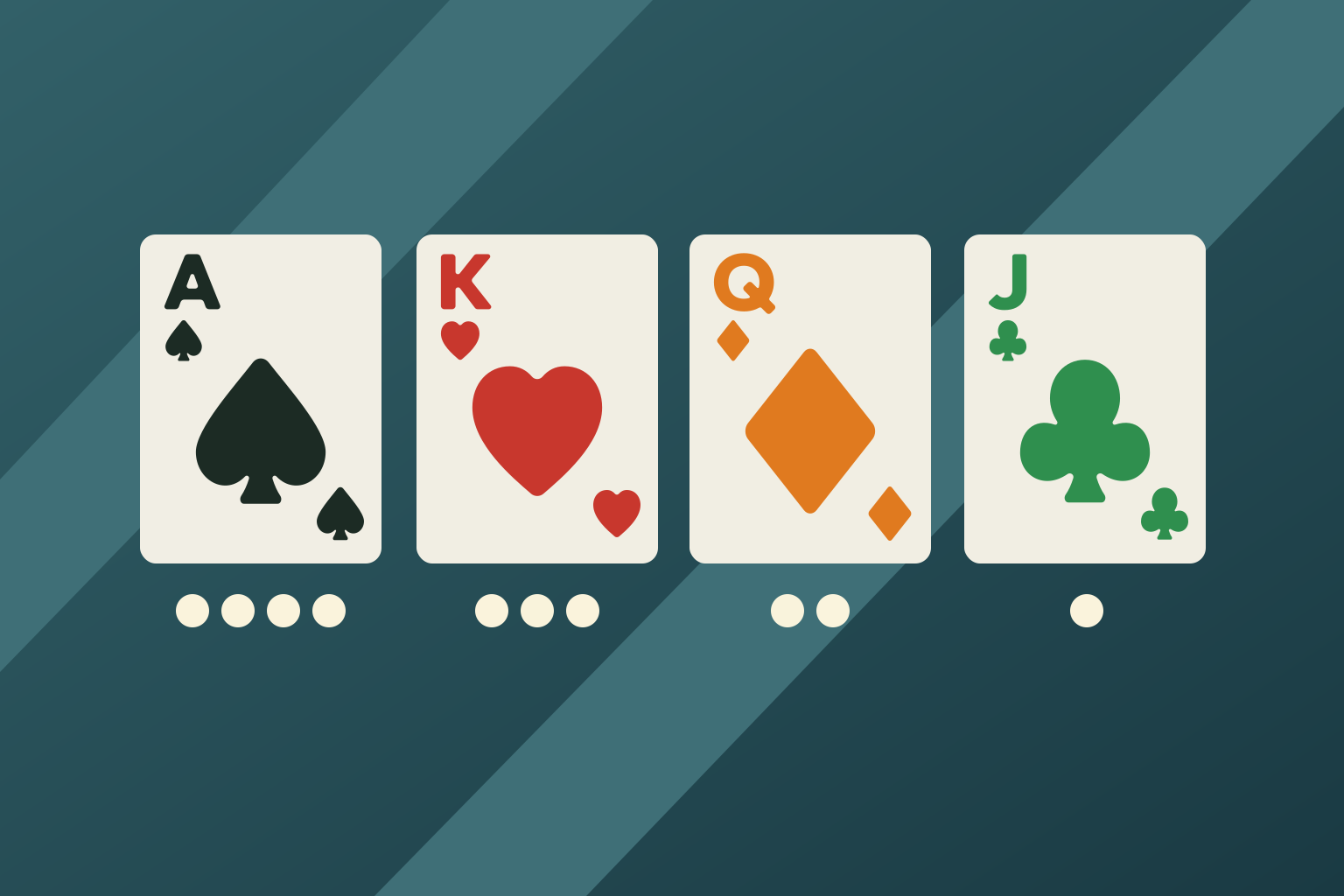
Each board is drawn the way a hand record prints it, with North at the top and the board number in the middle. The small figure beside each seat's name is that hand's high-card points, counted ace 4, king 3, queen 2 and jack 1, so the four figures always add up to 40.
- 1.Press Deal again for a new board. A single board walks on through the board numbers, so the dealer and the vulnerability change from one deal to the next.
- 2.Pick 4, 8, 16, 24 or 32 boards to deal a set numbered from 1. On a phone the boards stack, on a wider screen they sit two to a row.
- 3.Open Set conditions when you want particular hands, such as a strong notrump for North or a long suit for East.
- 4.Use the buttons under the boards to copy or download the set, or to print it.
Dealer and vulnerability follow the board number exactly as they do on a duplicate board. The dealer goes round the table, North on board 1, East on board 2, South on board 3, West on board 4, and North again on board 5. Vulnerability runs through a cycle of 16 boards, and boards 17 to 32 repeat it.
| Boards | Dealers | Vulnerable, in board order |
|---|---|---|
| 1 to 4 | North, East, South, West | None, North-South, East-West, Both |
| 5 to 8 | North, East, South, West | North-South, East-West, Both, None |
| 9 to 12 | North, East, South, West | East-West, Both, None, North-South |
| 13 to 16 | North, East, South, West | Both, None, North-South, East-West |
The positions guide explains what the seats and vulnerability mean at the table, and the duplicate bridge guide covers how boards travel round a club game.
What the conditions mean
Each seat takes a point range and a shape. Points are high-card points, from 0 to 37, the most one hand can hold. Leave a seat at 0 to 37 and any shape and it gets whatever the shuffle gives it.
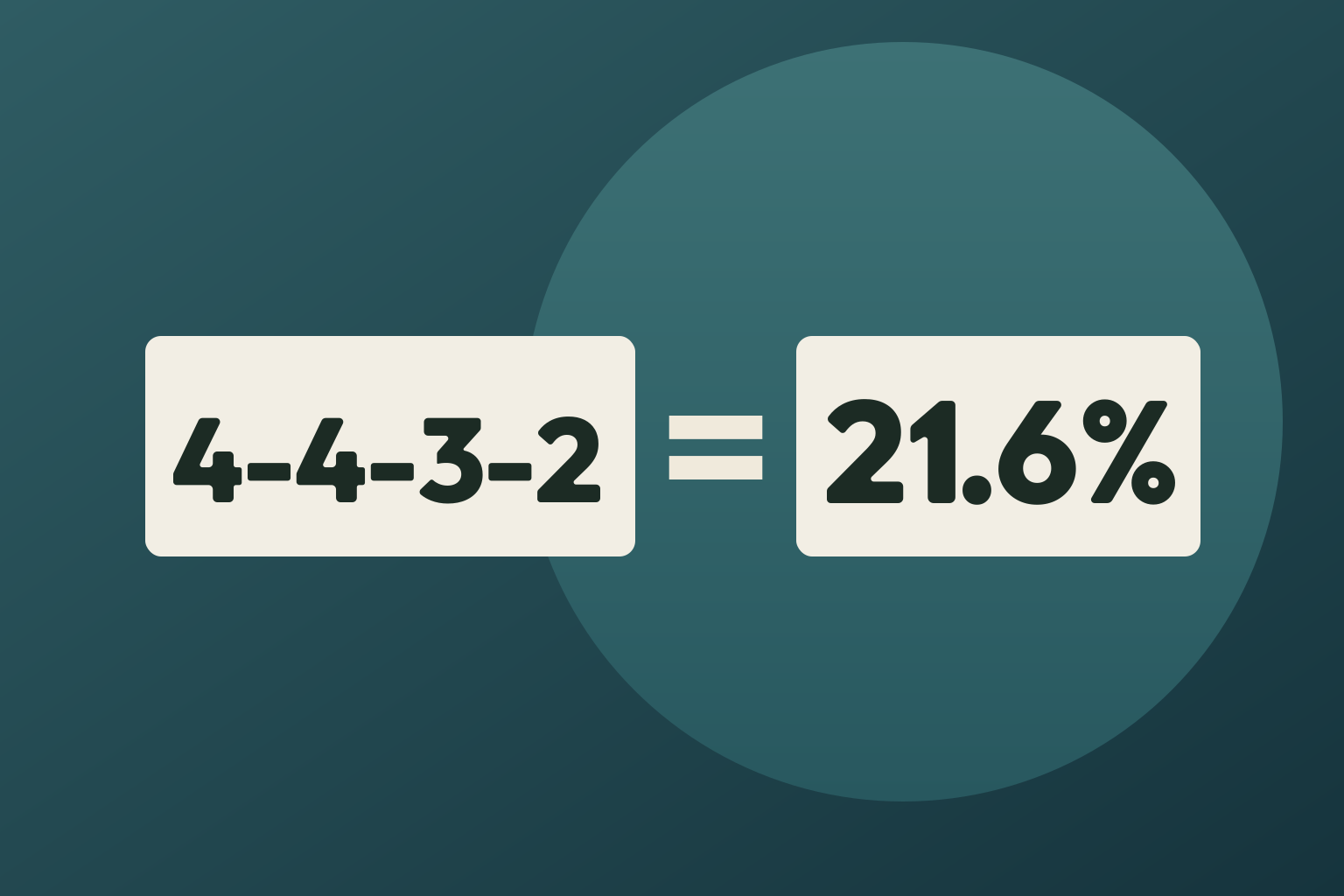
- Balanced accepts only the three balanced patterns, 4-3-3-3, 4-4-3-2 and 5-3-3-2. A balanced hand has no void, no singleton and at most one doubleton.
- Long spades, long hearts, long diamonds or long clubs asks for at least the number of cards you choose in that suit, from four to nine. Longer is fine, so five or more ♥ also accepts a hand with seven hearts.
- Semi-balanced accepts hands with no void and no singleton that are not balanced: 5-4-2-2, 6-3-2-2 and 7-2-2-2. These are the hands players often open 1NT or rebid notrump with by agreement.
- Unbalanced accepts any hand with a singleton or a void. Every hand is exactly one of balanced, semi-balanced or unbalanced.
The generator checks that the conditions make sense before it deals. The lowest point counts of the four seats cannot add up to more than 40, the highest ones must reach at least 40, and the seats cannot ask for more than 13 cards of one suit between them. A mistake shows up as a plain message under the conditions.
Some conditions are possible but rare. A balanced 22 to 24 for North turns up in about one deal in 470, and 25 points or more in about one in 2,200. Some combinations never happen at all. The generator shuffles the whole deck, deals the hardest seat first and starts again as soon as any seat misses, so every deal that meets your conditions is equally likely. It tries up to two million deals per board, which takes about a second, and then tells you if nothing fit. The hand patterns guide shows how often each shape comes up, which is a good guide to what will deal quickly.
| To practice | Set |
|---|---|
| 1NT openings and responses | North 15 to 17 points, balanced |
| Weak two bids | North 5 to 10 points, six or more ♠ |
| Overcalls and takeout doubles | East 12 to 21 points, South 8 or more points |
| Slam bidding | North 15 or more points, South 15 or more points |
| Defending a preempt | West 5 to 10 points, seven or more ♥ |
Dealer and vulnerability follow the board number, so the hand you set up is not always the first to speak. When you practice an opening or a preempt, start the auction with that hand whatever the board says.
Export formats: PBN, LIN and PDF
PBN (Portable Bridge Notation) is the plain text format almost every bridge program reads, from dealing machines to scoring software. Copy PBN puts the whole set on your clipboard, and Download PBN saves it as a .pbn file. Each board is a short block of tags.
- Board "6" is the board number.
- Dealer "E" names the dealer by its initial.
- Vulnerable "EW" takes None, NS, EW or All.
- Deal "E:JT9.AKQ2..AKQJT9 ..." holds the four hands. The letter before the colon names the first hand, which in these files is the dealer, and the other three follow clockwise. Inside a hand the suits run ♠ ♥ ♦ ♣, separated by dots, T stands for the ten, and a void is left empty, as in AKT4.Q32..J98765.
LIN is the format Bridge Base Online uses for its own hand records. Download LIN for BBO writes one line per board. The digit after md| is the dealer, 1 for South, 2 for West, 3 for North and 4 for East, and the hands follow in the order South, West, North, East. The letters after sv| give the vulnerability, o for none, n for North-South, e for East-West and b for both.
Print or save as PDF opens a clean page holding only the boards, six to a sheet, with the suits in color. Print it for the table, or pick Save as PDF as the printer in the dialog to keep a file you can email to a class or a partner.
Club dealing machines such as Duplimate and Dealer4 take a PBN file and sort real cards into the boards to match it, so the hands everyone plays are the hands on your hand record. On BBO, the host of a teaching table or a tournament can load prepared deals in place of random ones from its Deal Archive, which imports LIN files.
What players use it for
- Teaching. Set North to the hand your lesson is about, deal eight boards and print them. Each student gets a hand that fits the topic instead of waiting for one to come up.
- Partnership bidding practice. Deal a set of 16, each partner looks only at their own hand and writes down the auction, then compare. Every board where your auctions differ is worth a conversation.
- Checking a contract. Every board has an Analyze in the DD Solver link that opens the deal in the Double Dummy Solver, which shows how many tricks each side can take in every strain.
- Bigger questions. To ask how often 4♠ makes opposite a given hand over thousands of deals, use the Bridge Lab simulator, which deals and solves in bulk.
Common questions
Short answers to what readers ask most.
- Is this bridge hand generator free?
- Yes. It deals in your browser with no sign-up, no credits and no limit on how many boards you deal or export.
- Are the deals really random?
- Each deal is a full shuffle using the browser's random numbers, so every deal is equally likely. With conditions set, every deal that meets them is equally likely. That is plenty for teaching and practice, though it is not a certified dealer for official events.
- How do I load the hands into BBO?
- Download the LIN file. On BBO, open Account, then Deal Archive, make a folder and use Import LIN file. When you start a teaching table or a tournament, choose that folder as the deal source.
- What is a PBN file?
- A plain text file in Portable Bridge Notation, the standard way to store bridge deals. Each board has tags for its number, dealer, vulnerability and the four hands, and dealing machines, scoring programs and solvers all read it.
- Can I choose the vulnerability?
- Vulnerability follows the board number, as on a real board, so neither side is vulnerable on board 1 and both sides are on board 4. The dealer follows the board number in the same way.
- Why does the generator say my conditions are too rare?
- It found no deal that fit in two million tries. Either the hand cannot exist, such as eight spades and 37 points, or it is so rare that a shuffle almost never produces it. Widen a point range or ask for a shorter suit and deal again.
Practice: reading dealt hands
Eight quick questions on what you just read. For a longer session, take the hundred-question quiz.