Duplicate Bridge
Duplicate bridge is the competitive form of the game in which every table plays the same deals, so the result depends on how well a pair bid and played each hand compared with the other pairs who held the same cards, and not on the luck of the deal.
Updated 14 October 2026
A duplicate board is a plastic or metal tray with four pockets marked North, East, South and West. Each pocket holds one hand of 13 cards, and the tray travels from table to table through the evening. When you take your cards out, you play them, then put them back in the same pocket for the next pair to play. By the end of the session the same deal has been bid and played by several pairs, and that repetition is the whole basis of the scoring.
What is duplicate bridge?
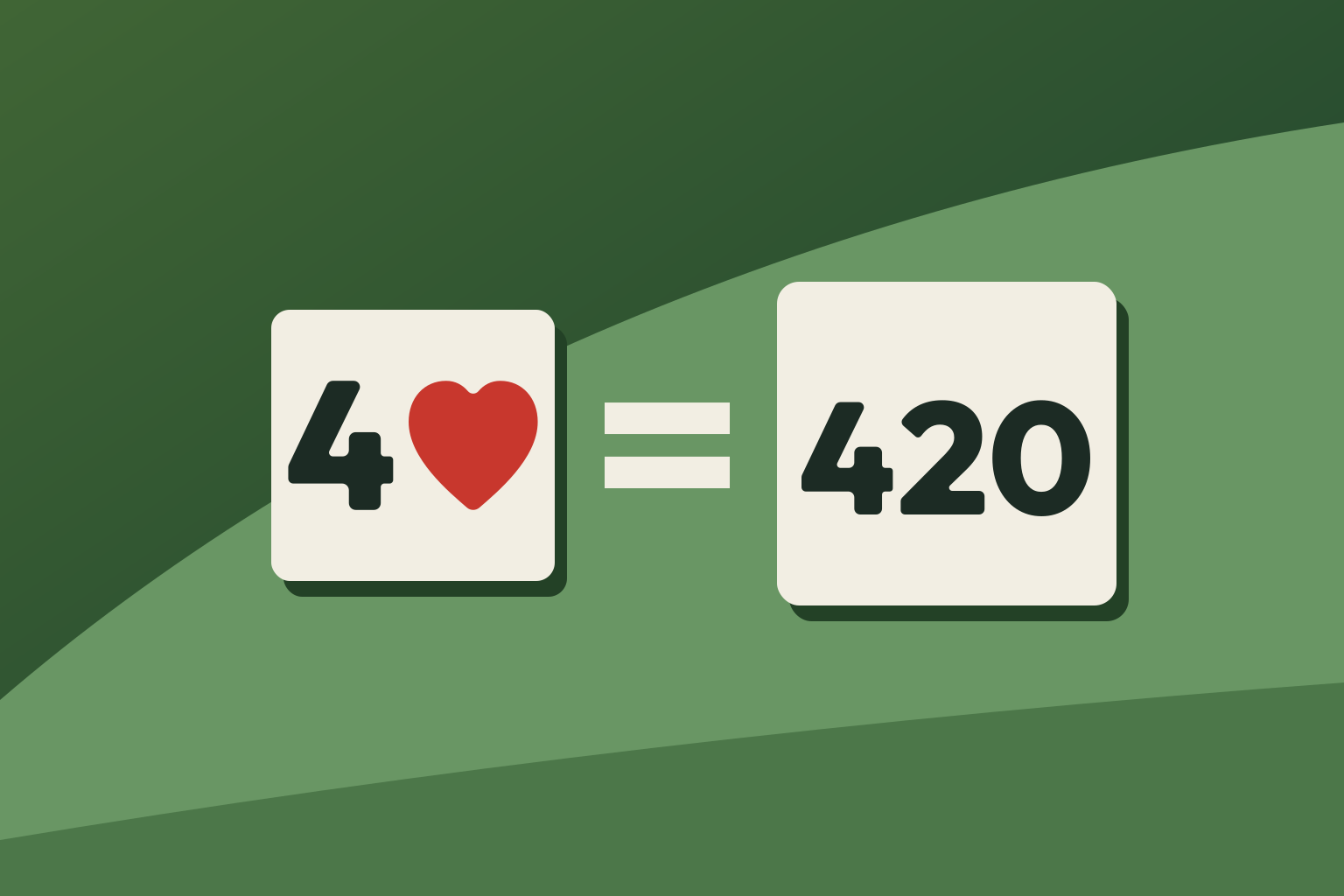
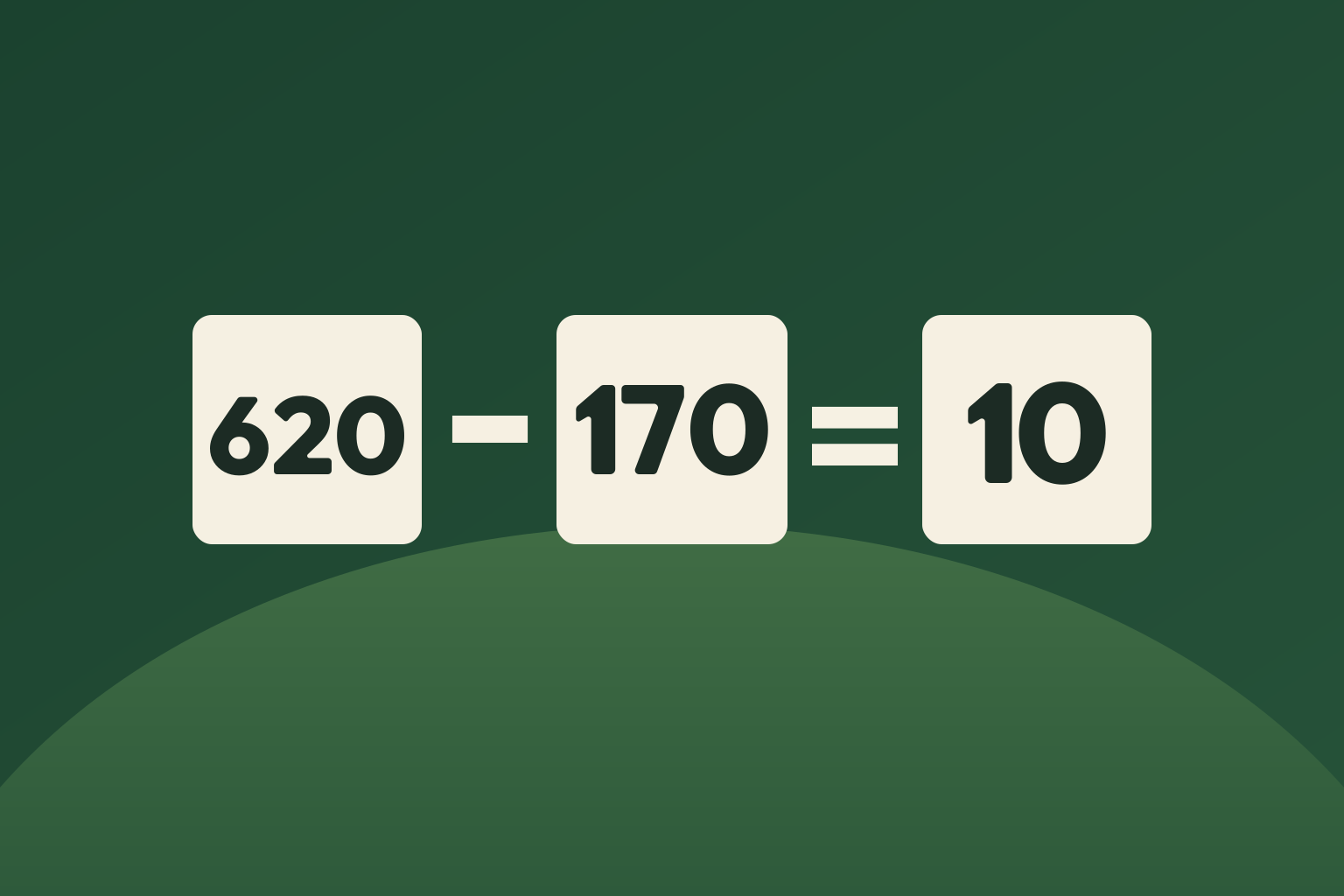
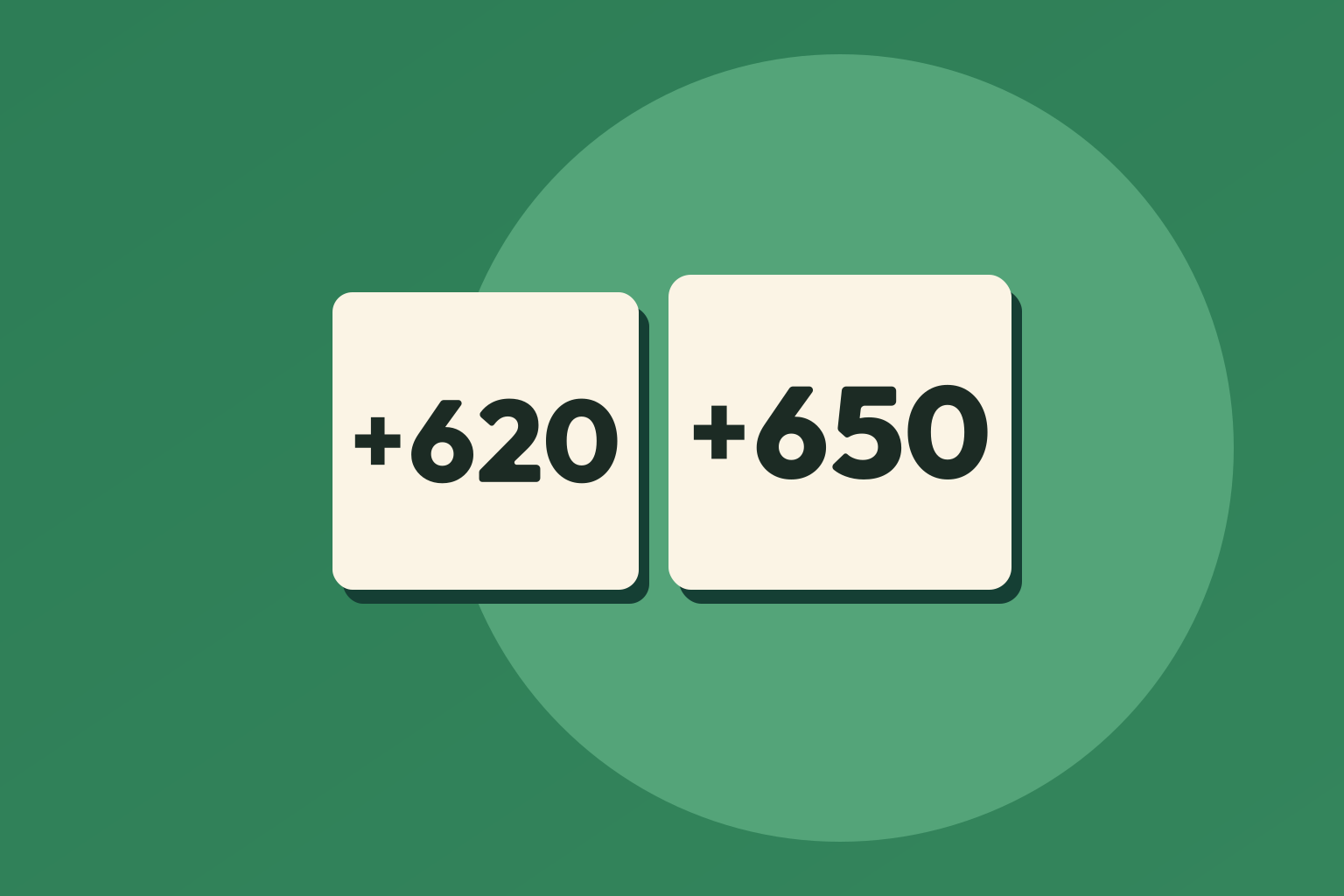
Duplicate bridge is bridge played so that every pair, or every team, plays the same deals and is scored by comparison with the others who held the same cards. The bidding and the play follow the ordinary rules of contract bridge, set out in the bridge rules guide. The difference is in what counts. At rubber bridge a pair dealt strong cards all evening wins, however badly it plays them. At duplicate a pair that collects +420 for a vulnerable game when the other North-South pairs collected +620 has had a poor board, even though the score sheet shows a plus.
Holding the deals constant removes most of the luck of the cards, though not all of it, since the opponents you meet on a board can help or hurt you. Over a session of 24 or more boards those swings tend to even out, and the pairs who bid and play well finish near the top much more often than chance would allow.
Nearly all organized competitive bridge is duplicate, in clubs, at tournaments up to world championships, and online. If you are new to the game, the how to play bridge tutorial covers the deal, the auction and the play first.
How a duplicate game runs
A club duplicate needs at least three tables in practice. Each pair is given a pair number and a starting table and seat. The director, the official who runs the game, hands out the boards, sets the movement and settles any irregularity at the table.
The boards
Every board carries a number, and the number fixes the dealer and the vulnerability. Board 1 has North dealing with neither side vulnerable, board 2 has East dealing with North-South vulnerable, and so on through a 16-board cycle that then repeats. The dealer's pocket and the vulnerable seats are printed or colored on the tray, so nobody needs to remember the cycle. The bridge positions guide has the full 16-board table. Many clubs deal the boards in advance by computer and hand out hand records after the game, showing all four hands of every board and the tricks available in each contract.
Bidding boxes and alerts
Most clubs bid with bidding boxes, a box of printed cards for every call, placed on the table in turn instead of spoken. Nobody can then read anything into a partner's tone of voice. A call with a conventional meaning the opponents might not expect is alerted, by tapping or showing the alert card, and the opponents may ask what it means when it is their turn to call.
Playing the cards
Played cards do not go into the middle of the table. Each player keeps his own cards in front of him, face down after each trick, turned lengthwise toward the side that won it. At the end everyone can count the tricks from their own row, and the four hands go back into their pockets intact.
Keeping the score
North usually keeps the score for the table. In some clubs each board carries a folded traveler, a slip on which every table writes its contract and result. The last table to play the board then sees all the scores. Most clubs now use a wireless scoring terminal at each table, the best known being the Bridgemate, which sends each result straight to the director's computer. East or West checks the entry before it is confirmed.
A typical club session is 24 to 28 boards, played in rounds of two to four boards against the same pair. Play runs at about seven or eight minutes a board, and the whole session runs about three to three and a half hours. When the director calls the move, pairs and boards change places according to the movement.
Duplicate bridge movements: Mitchell and Howell
A movement is the schedule that tells each pair where to sit and which boards to play in each round. The two that every club uses are the Mitchell and the Howell.
In a Mitchell movement the North-South pairs stay at their tables all session. After each round the East-West pairs move up one table and the boards move down one table. A pair therefore never meets the same boards twice, and every North-South pair plays against a long run of East-West pairs. Each North-South pair is compared only with the other North-South pairs, and East-West only with East-West, so a Mitchell produces two winners, one in each direction. With an even number of tables the moving pairs would arrive at boards they have already played, and the director fixes that with a skip halfway through or with a bye stand of boards nobody plays that round.
In a Howell movement every pair moves, following a guide card that tells it the next table and seat. Pairs play some boards North-South and some East-West, so every pair can be ranked in one field and there is one winner. Howells suit small games of three to about seven tables, where a Mitchell would leave each pair meeting only a few opponents. Bigger games use a Mitchell, sometimes with arrow-switching, in which the pairs turn the board around for one or more rounds so the two directions can be combined into a single field.
| Mitchell | Howell | |
|---|---|---|
| Who moves | East-West pairs up one table, boards down one | Every pair, by guide card |
| Who stays put | North-South pairs | Usually one pair at most |
| Winners | Two, one North-South and one East-West | One overall |
| Usual field size | Any, most often five tables or more | Three to about seven tables |
| Comparison | Within your own direction | Against every pair |
How is a matchpoint result scored?
At matchpoints your score on a board is compared with every other pair who held the same cards, and you earn 1 matchpoint for each pair you beat and half a matchpoint for each pair you tie. The raw scores come from the ordinary scoring table. Only their order matters, not the size of the gaps between them. The best possible result on a board, called a top, is one less than the number of times the board was played. Outside North America many clubs give 2 points per pair beaten and 1 per tie, which doubles every figure without changing the ranking.
Here is one board played five times, with nobody vulnerable. Four North-South pairs reached 4♠ and one stopped in a part score. The top is 4.
| Table | Contract and result | N-S score | Beats | Ties | N-S matchpoints | E-W matchpoints |
|---|---|---|---|---|---|---|
| 1 | 4♠ by South, 11 tricks | +450 | 4 | 0 | 4 | 0 |
| 2 | 4♠ by South, 10 tricks | +420 | 2 | 1 | 2.5 | 1.5 |
| 3 | 4♠ by North, 10 tricks | +420 | 2 | 1 | 2.5 | 1.5 |
| 4 | 3♠ by South, 10 tricks | +170 | 1 | 0 | 1 | 3 |
| 5 | 4♠ by South, 9 tricks | -50 | 0 | 0 | 0 | 4 |
The North-South matchpoints add up to 4 + 2.5 + 2.5 + 1 + 0 = 10, which is the five results times the top of 4, divided by two. Each East-West pair scores the top minus its opponents' matchpoints, so the two directions together always share the top at every table. The overtrick at table 1 was worth a full matchpoint and a half over the pairs who made ten tricks, although it was only 30 points.
Your session result is the total of your matchpoints divided by the total available, given as a percentage. An average game is 50 percent, a score in the high 50s usually places in a club game, and 60 percent or more is a very good session.
Because each board is scored on its own, a small score can be worth more than a large one. A pair who make +110 in a part score where every other pair went down for -50 or -100 earns a top. A pair who make +600 for a vulnerable 3NT on a board where every other pair made an overtrick for +630 earns a bottom. The habits that follow are well known to club players. Overtricks matter, notrump scores 10 more than a major for the same number of tricks, and conceding a small penalty can be better than letting the opponents make a part score. The scoring guide has a short section on how matchpoints and IMPs change the play.
Team games and IMPs
In a team game two pairs form a team of four. One pair sits North-South at one table and the other sits East-West at the other, and the same boards are played at both tables. At the end of the match each board's two scores are added, and the net difference is converted with the IMP scale. IMPs, International Match Points, run from 0 for a difference under 20 points up to 24 for a difference of 4000 or more, and the full scale is on the IMP table page.
The two common team events are the Swiss, in which teams play a series of short matches of six to twelve boards and are paired each round with teams on a similar score, and the knockout, in which the losing team of each match drops out. A team game feels different from a pair game. An overtrick is rarely worth more than 1 IMP, while going down in a vulnerable game that the other table made costs double figures. Teams players protect their contract with safety plays, bid vulnerable games on less than an even chance, and stop worrying about the extra trick. The game and slam odds guide works out how thin a game or slam should be bid at IMPs.
Some pair games are scored at IMPs too, by Butler or cross-IMP scoring, and the scoring guide explains both. A third method, board-a-match, scores each board of a team game as a win, tie or loss and is used mainly in a few national team championships.
Duplicate bridge vs rubber bridge and Chicago
All three forms use the same cards and the same auction rules. Rubber bridge carries scores from deal to deal until one side wins two games, Chicago plays sets of four deals with fixed vulnerability, and duplicate scores each board alone and then compares it. The scoring guide has the bonuses for each.
| Rubber bridge | Chicago | Duplicate | |
|---|---|---|---|
| Players needed | Four | Four | At least three tables of four in practice |
| Deals | Shuffled and dealt at the table until a side wins two games | Sets of four deals, shuffled at the table | Pre-dealt boards, typically 24 to 28 in a session |
| Who you play | The same three people, often changing partners after each rubber | The same three people | A different pair every round |
| What decides the result | Total points at the end, including the rubber bonus | Total points over the sets played | Your score compared with others who held the same cards |
| Luck of the cards | Large | Large | Mostly removed |
| How long it takes | A rubber is usually 20 to 40 minutes | A set of four deals is about 30 minutes | Three to three and a half hours a session |
Home games choose rubber or Chicago because four people are enough. Duplicate needs a room, a director and a movement.
Duplicate bridge rules, clubs, convention cards and masterpoints
Duplicate is played under the Laws of Duplicate Bridge, written by the World Bridge Federation. The current edition dates from 2017, and the ACBL publishes it in North America. The laws cover the auction, the play, claims and every irregularity, from a lead out of turn to a revoke, and the director applies them at the table. When something goes wrong, the correct step is to call the director rather than settle it among the four players.
Clubs are organized through national bodies. In North America that is the American Contract Bridge League (ACBL), which sanctions club games and runs the tournament calendar. In England it is the English Bridge Union (EBU), and most countries have an equivalent federation under the WBF. Most clubs allow the common conventions freely and restrict only unusual methods.
Every pair is expected to have a convention card, a one-page summary of its bidding system and its leads and signals, on the table for the opponents to read. Many club players start from the Standard American Yellow Card or a local standard and note their own changes. You can fill one out and keep it online with the convention card editor.
Masterpoints are the ranking awards for placing in sanctioned events. The ACBL gives them for finishing places in club games and tournaments, in different colors for different levels of event, and a player climbs through a series of ranks as the total grows. Life Master requires 500 masterpoints, with a minimum share earned at tournaments in the colored categories, and the ranks continue above it to Grand Life Master. The EBU and other federations run their own master point schemes with their own ranks.
Playing duplicate bridge online
The large bridge platforms all run duplicate, against human pairs or against robots. In a robot game you play every board with a robot partner against robot opponents and are matchpointed against everyone else who played the same set. Robot games are a good way to get used to boards and matchpoint thinking before a first club game.
Two skills pay off quickly at duplicate, the opening lead and the handling of a single suit, because every pair faces the same decision and the difference shows up on the score sheet. The lead trainer and the suit trainer practice exactly those, and the opening leads guide covers the standard choices. When you are ready for a bigger room, bridge tournaments explains how sectionals, regionals and the national events work, and the glossary has the words the director uses.
Common questions
Short answers to what readers ask most.
- What is duplicate bridge?
- Duplicate bridge is the form of bridge in which every table plays the same pre-dealt boards. Each result is scored by comparison with the other pairs or teams who held the same cards, so skill counts for far more than the luck of the deal.
- How is duplicate bridge different from regular bridge?
- The bidding and play are the same, but the scoring is comparative. In rubber or Chicago bridge you win by scoring more points than the other side at your table. In duplicate you win by doing better with your cards than the other pairs who played them.
- How is duplicate bridge scored?
- Each board gets an ordinary bridge score, which is then compared with the other results on the board. Pair games usually use matchpoints, 1 point for each pair you beat and half for each tie, and team games convert the difference between the two tables into IMPs.
- How many boards are played in a duplicate session?
- A typical club session is 24 to 28 boards. They are played two to four at a time against each opposing pair and take about three to three and a half hours in all.
- What is a Mitchell movement?
- A Mitchell movement is the usual way to run a club pair game. North-South pairs stay at their tables, East-West pairs move up one table each round and the boards move down one, and there is a winner in each direction.
- Do I need a partner to play duplicate bridge?
- Usually yes, since duplicate is played in fixed pairs. Most clubs keep a partnership desk or a list of players looking for a game, and many will find a partner for a newcomer if you ask the director before the session.
- What are masterpoints in bridge?
- Masterpoints are awards for placing in sanctioned club games and tournaments. In North America the ACBL tracks them, and a player's total sets a rank, with Life Master at 500 points including a share won at tournaments.
Practice: duplicate bridge
Eight quick questions on what you just read. For a longer session, take the hundred-question quiz.