Bridge Bidding
Bridge bidding is the auction at the start of every deal, in which the two partnerships describe their hands with bids and settle on a contract: a number of tricks and a trump suit, or notrump.
Updated 14 October 2026
Before anyone plays a card, the four players hold an auction. It decides which side will play the deal, which suit will be trumps (or whether there will be none) and how many tricks that side has to win. Partners cannot show each other their cards or talk about them, so the bids are the only way they have to describe their hands. This page explains how the auction works and then walks through bidding a hand from the first bid to the final contract, in the standard style most new players in North America learn.
If you are new to the game as a whole, start with how to play bridge, which covers the deal, the play and the score. Come back here when you want to bid with a plan.
What bidding is for
The auction ends in a contract. A contract has a level from 1 to 7 and a strain, which is one of the four suits or notrump. The level counts tricks above six, so a contract of 2♠ asks the declaring side to win eight of the thirteen tricks with spades as trumps, and 3NT asks for nine with no trumps at all.
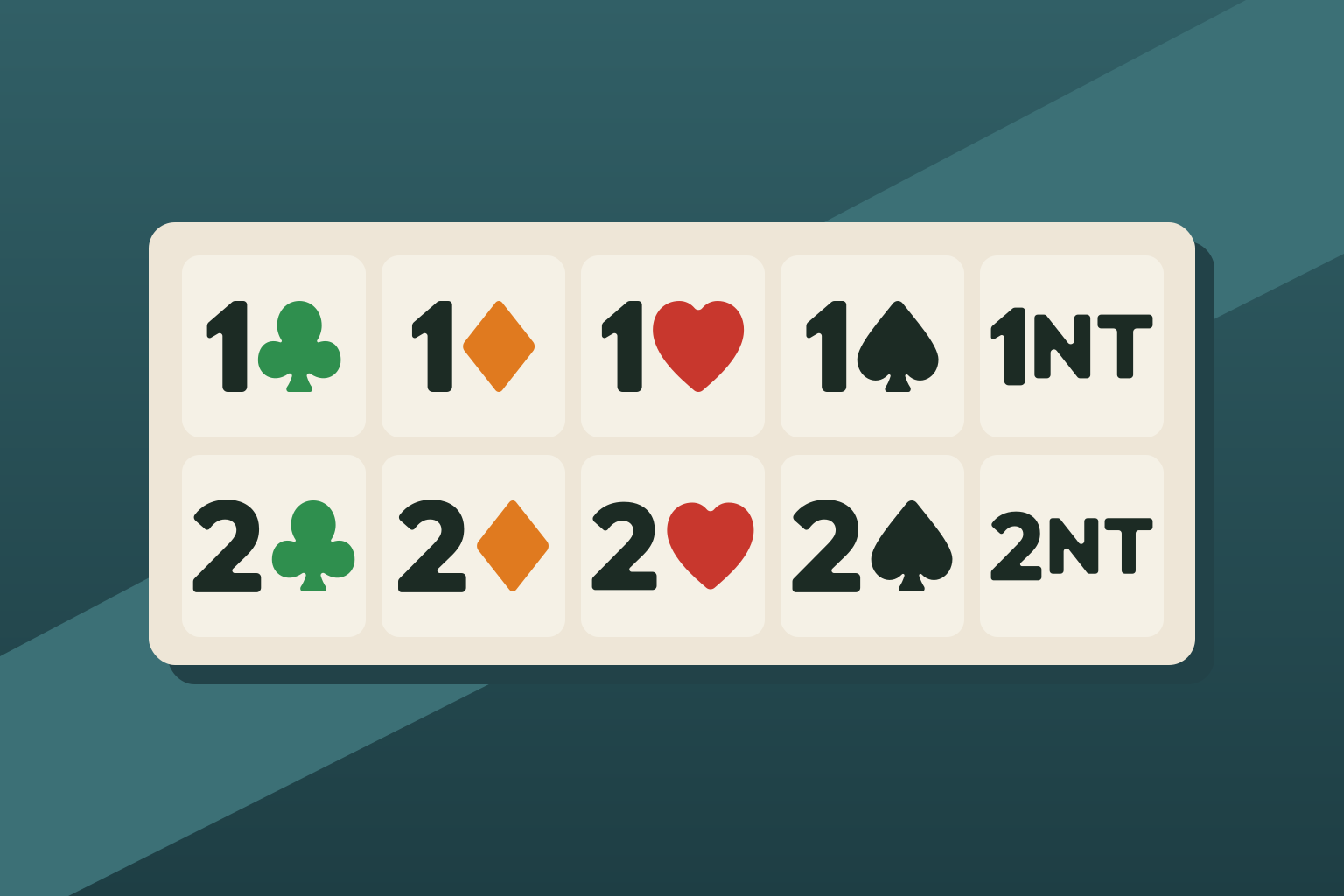
Every bid must be higher than the one before it. A bid is higher if it is at a higher level, or at the same level in a higher strain. The strains rank from the bottom as clubs, diamonds, hearts, spades and notrump. That gives a ladder of 35 bids, from 1♣ at the bottom to 7NT at the top, and each bid in the auction has to climb it.
| Call | When you can make it | What it does |
|---|---|---|
| A bid, such as 1♥ | Any time, if it is higher than the last bid | Offers a contract and describes your hand |
| Pass | Any time | Makes no bid this turn. You can still bid later if the auction goes on |
| Double (X) | Only when the last bid was made by an opponent | Raises the stakes, or by agreement asks partner to bid |
| Redouble (XX) | Only after an opponent has doubled your side | Raises the stakes again |
The dealer calls first, and the turn passes clockwise. Once anyone has bid, the auction ends when three players pass in a row, and the last bid becomes the contract. If all four players pass at the start, the deal is thrown in. Of the two partners who won the auction, the one who first named the strain of the contract is the declarer. The other one becomes the dummy. The fine print, such as what happens after a bid out of turn or an insufficient bid, is in the rules of bridge.
Counting your hand
Most players value a hand with high-card points: 4 for an ace, 3 for a king, 2 for a queen and 1 for a jack. The deck holds 40 points, so an average hand has 10. Long suits add value, because the small cards in them can win tricks once the high cards are gone, and the usual way to count them is to add a point for each card over four in a suit. Short suits become valuable once you have found a trump fit and can ruff. The hand evaluation guide covers these adjustments in full.
The reason for counting is that the combined points of the two hands predict how high the partnership can go. Bidding is mostly the business of adding your points to partner's and seeing which of these targets you reach.
| Combined points | Target | Tricks |
|---|---|---|
| Under 25 | A part score, stop as low as you can | 7 to 9 |
| 25 to 26 | Game in 3NT, 4♥ or 4♠ | 9 or 10 |
| About 29 | Game in 5♣ or 5♦ | 11 |
| About 33 | Small slam | 12 |
| About 37 | Grand slam | 13 |
Game earns a large bonus, which is why so much of bidding is about finding out whether the two hands hold 25 points between them. A minor-suit game needs eleven tricks, so with a choice most pairs prefer 3NT or four of a major. How often a game or slam has to make before it is worth bidding is on the game and slam odds page.
Opening the bidding
The first bid of the auction is the opening bid. The methods on this page are Standard American with five-card majors, the base of the SAYC card and of two over one, and they match our bridge bidding cheat sheet. Open the bidding with 12 or more high-card points. A hand with 11 and a long suit can open too, and the rule of 20 is the usual test for it.
Which bid to open depends on the shape of the hand. Work through these in order and stop at the first that fits.
- 1.22 or more points: open 2♣, the one strong bid. It says nothing about clubs and forces partner to respond. The strong 2♣ guide shows how the auction continues.
- 2.A balanced hand (4-3-3-3, 4-4-3-2 or 5-3-3-2) of 15 to 17 opens 1NT, and one of 20 to 21 opens 2NT.
- 3.A five-card or longer major opens one of that major. If you hold five hearts and five spades, open 1♠, the higher.
- 4.No five-card major: open your longer minor. Open 1♦ with four cards in each minor and 1♣ with three in each.
Weaker hands with one long suit have bids of their own. A good six-card suit and 5 to 11 points can open a weak two in diamonds, hearts or spades, and a seven-card suit with less than an opening hand can open at the three level, which is covered under preempts. Both aim to take bidding space away from the opponents more than to describe a good hand.
Responding to partner's opening
After partner opens one of a suit, you respond with 6 points or more. Below that, game is unlikely even opposite a good opening, and you can pass. When you do respond, your first job is to look for a trump fit, ideally eight cards or more between the two hands in a major suit.
- Support partner's major if you hold three or more cards in it. A raise to the two level shows 6 to 10 points, and a jump to the three level, the limit raise, shows about 10 to 11.
- Bid a new suit of four or more cards. At the one level it needs 6 points, at the two level about 10. A new suit is forcing, which means opener must bid again.
- Bid 1NT with 6 to 10 points and nothing better to say. It is a limited bid and opener may pass it.
- Over a minor-suit opening, bid a four-card major before you think about supporting the minor or bidding notrump. Bid four-card suits from the cheapest up, so with four hearts and four spades over 1♣, respond 1♥.
Over a 1NT opening, responder already knows a lot. Opener has 15 to 17 and a balanced hand, so responder adds points and decides. A balanced hand of 0 to 7 passes, 8 or 9 invites with 2NT, and 10 to 15 bids 3NT. Hands with a four-card or five-card major use Stayman and Jacoby transfers, the first two conventions most players learn.
Opener's rebid
Opener's second bid narrows the range of the opening. A one-level opening can be anything from 12 to 21 points, and responder needs to know which part of that range opener holds. Opener does it by choosing a rebid from one of three bands.
| Opener holds | Points | Typical rebids |
|---|---|---|
| Minimum | 12 to 15 | 1NT (balanced 12 to 14), a single raise, rebid the suit, a new suit lower than the first |
| Medium | 16 to 18 | A jump raise, a jump in your own suit, a reverse |
| Maximum | 19 to 21 | A jump to game, 2NT (18 to 19 balanced), a jump in a new suit |
Opener also keeps the search for a fit going. If responder bids a suit opener holds four of, opener raises it. If not, opener shows a second suit or rebids notrump with a balanced hand. Opener's 1NT rebid denies a four-card holding in responder's major, which matters in the second worked auction below.
Forcing, invitational and sign-off bids
Every bid after the opening falls into one of three kinds, and knowing which kind partner has just made tells you if you are allowed to pass.
| Kind | What partner does | Examples in standard bidding |
|---|---|---|
| Forcing | Must bid again | A new suit by responder, a 2♣ opening, a jump in a new suit |
| Invitational | Bids game with a good hand, passes with a poor one | A limit raise, 2NT over 1NT, opener's jump rebid in the suit |
| Sign-off | Should pass | A game bid, a return to partner's suit at the lowest level, 3NT over 1NT |
A bid that shows a narrow range of points and a known shape is called a limit bid: a raise, a notrump bid, a limit raise. After a limit bid, the partner who has not yet limited the hand knows the most and becomes the captain. The captain places the contract or invites, and the other partner follows. A new suit, by contrast, keeps the auction open because the hand behind it could be minimum or very strong.
One exception catches many newer players. A new suit is forcing only if responder has not passed already. A passed hand has shown under 12 points, so opener may pass its new suit.
Reaching game: four worked auctions
The four auctions below show the steps above working together. North-South are the bidders, East-West pass unless shown, and nobody is vulnerable.
A major-suit fit and a jump to game
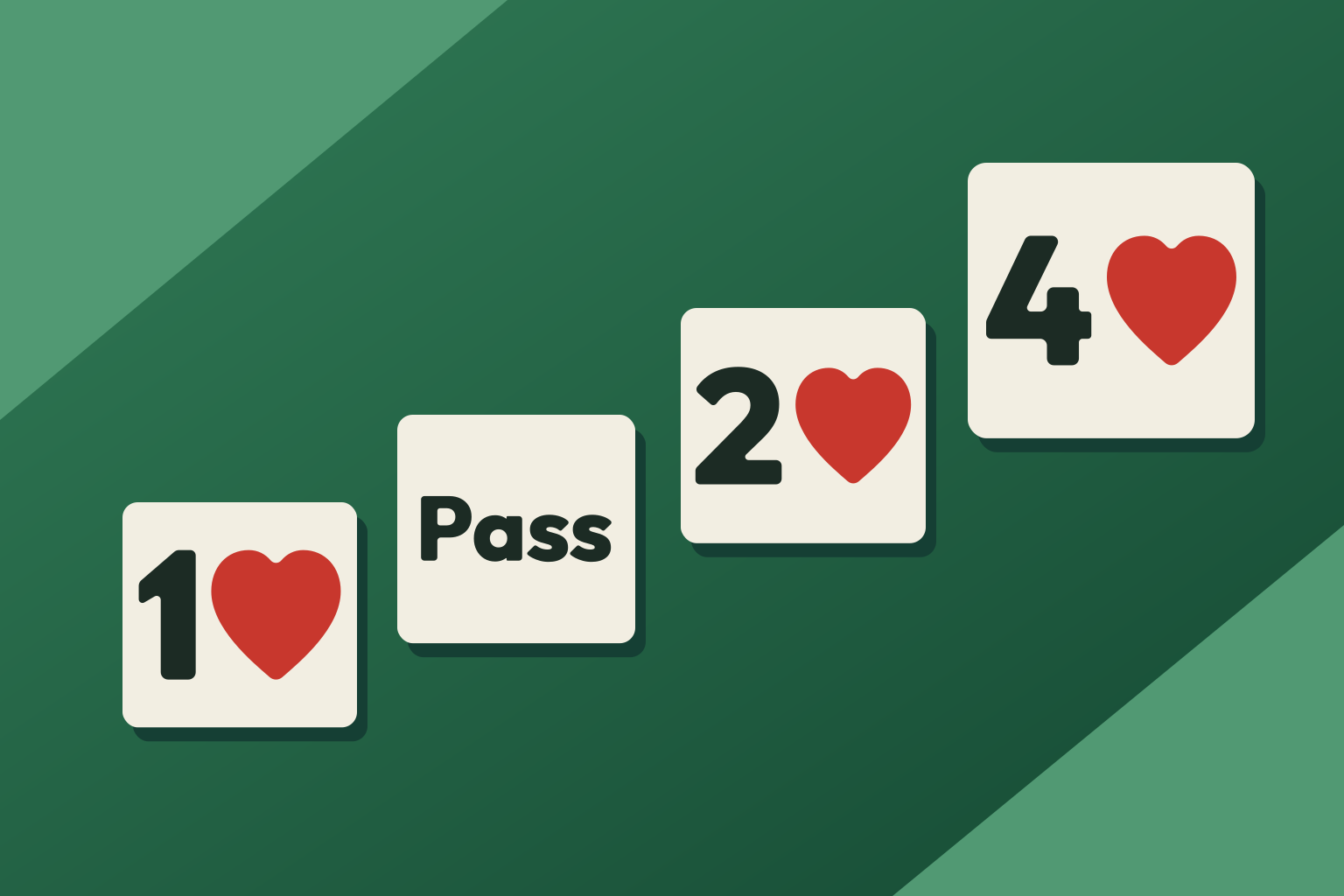
North opens 1♥, the five-card major. South has a fit and 8 points, so raises to 2♥, a limit bid showing 6 to 10. North is now the captain. North's 18 high-card points and two length points for the six-card suit come to 20, and South's 6 to 10 bring the total to at least 26, enough for game, so North bids 4♥. There is no reason to invite when game is certain. Ten tricks score 420 not vulnerable.
No major fit, so notrump
North has no five-card major and opens the longer minor, 1♦. South bids the four-card spade suit, which is forcing. North's 1NT rebid shows a balanced 12 to 14 and denies four spades, since North would have raised with them. South now knows there is no spade fit and that the two hands hold at least 25 points, so South signs off in 3NT.
An invitation declined
North opens 1NT, 15 to 17. South adds 9 to 15 and gets 24, just short of the 25 for game, so South invites with 2NT. North has 15, the bottom of the range, and passes. Holding 16 or 17, North would have gone on to 3NT. The partnership stops in a part score that should make, rather than a thin game.
When the opponents open: a takeout double
East opens 1♥. South has an opening hand but no five-card suit to overcall with, and is short in hearts with support for everything else, the classic takeout double. North must answer, even with very little, and bids the four-card spade suit at the cheapest level. South knows North could have nothing at all and passes.
When the opponents bid
Once an opponent has opened, your side is competing. The bids work differently, because you are trying to find a fit and get in the way of the opponents at the same time, with less room to do it.
- An overcall is a bid in a new suit after an opponent opens. It shows about 8 to 16 points and usually a good five-card suit, and it suggests a lead to partner. The overcalls guide covers when a suit is good enough.
- A 1NT overcall shows the same hand as a 1NT opening, give or take a point (15 to 18), with a stopper in their suit.
- A takeout double shows an opening hand, shortness in their suit and support for the unbid suits. It asks partner to choose the trump suit.
- Responder's double after partner opens and the next player overcalls is a negative double, usually showing the unbid major.
A pass is often right. If the opponents open and you hold 11 points with no good suit and the wrong shape to double, passing loses nothing, and the auction may come back to you.
Bidding systems and conventions
A bidding system is the full set of agreements a partnership plays: what each opening shows, how responses work and which conventions are on. In North America most players start with Standard American, written down as the SAYC card, and many move on to two over one game force, where a two-level response in a new suit forces to game. In Britain the common system is Acol, with four-card majors and a weak 1NT of 12 to 14. Precision opens an artificial 1♣ with nearly every hand of 16 points or more. A system is something you agree with a partner, and two strangers usually fall back on the common standard of their country.
A convention is a single bid with an agreed artificial meaning, such as 2♣ over partner's 1NT asking for a four-card major. Conventions must be agreed in advance and explained to the opponents when they ask. The bridge conventions page lists the common ones by situation, and each has its own guide. A beginner can play well with Stayman, Jacoby transfers and Blackwood and leave the rest for later.
To write your own agreements down, the Bidding Architect lets you build a system as a tree of bids, and you can start one without an account. Its practice mode turns a system into flashcards, and if you have no system of your own yet you can try a session on a ready-made 2/1 Game Force system. The seats and the words the auction uses are set out in bridge positions and bridge terms.
Common beginner mistakes in bidding
- 1.Passing a forcing bid. When responder bids a new suit, opener must bid again, even with a minimum. Passing can leave the partnership in a silly contract or miss a game.
- 2.Showing the same values twice. If you have already described your hand with a limit bid, let partner decide. Bidding again because you like your hand counts the same points a second time.
- 3.Rushing to notrump. Look for an eight-card major fit first. A 4-4 fit in a major usually plays a trick better than notrump, and it is easy to miss when responder skips over a four-card major.
- 4.Opening without a rebid in mind. Before you open, decide what you will rebid over partner's likely responses. If no rebid works, choose a different opening.
- 5.Overcalling on a poor suit. An overcall suggests a lead. Five small cards headed by a jack invite partner to lead from the wrong place.
- 6.Using conventions you have not agreed. If partner does not know that 2♣ over 1NT is Stayman, it is just a club bid. Agree a short list and stick to it.
Common questions
Short answers to what readers ask most.
- What are the basic rules of bridge bidding?
- Each player in turn, starting with the dealer, may bid, pass, double or redouble. Each bid must be higher than the last, by level or by strain, and the auction ends when three players pass in a row after a bid. The last bid becomes the contract.
- How many points do you need to open the bidding in bridge?
- Usually 12 high-card points or more. A hand with 11 and a long suit can open too, and a balanced hand of 15 to 17 opens 1NT.
- What does a bid of 1♠ mean in bridge?
- As a contract, 1♠ means winning seven tricks with spades as trumps. As an opening bid in Standard American it shows about 12 to 21 points and at least five spades.
- What is a forcing bid in bridge?
- A forcing bid is one partner must not pass. The usual examples are a new suit by an unpassed responder and the strong 2♣ opening.
- What is the best bidding system for beginners?
- In North America, Standard American with five-card majors, as on the SAYC card, is the usual first system because nearly everyone knows it. In Britain, beginners usually learn Acol. Learn the one your club or partners play.
- Can you bid again after passing in bridge?
- Yes. A pass only declines to bid in that turn, and you may bid at your next turn if the auction is still open. The auction ends only after three passes in a row following a bid.
Practice: bidding a hand
Eight quick questions on what you just read. For a longer session, bid a hundred hands or take the hundred-question quiz.