The History of Bridge
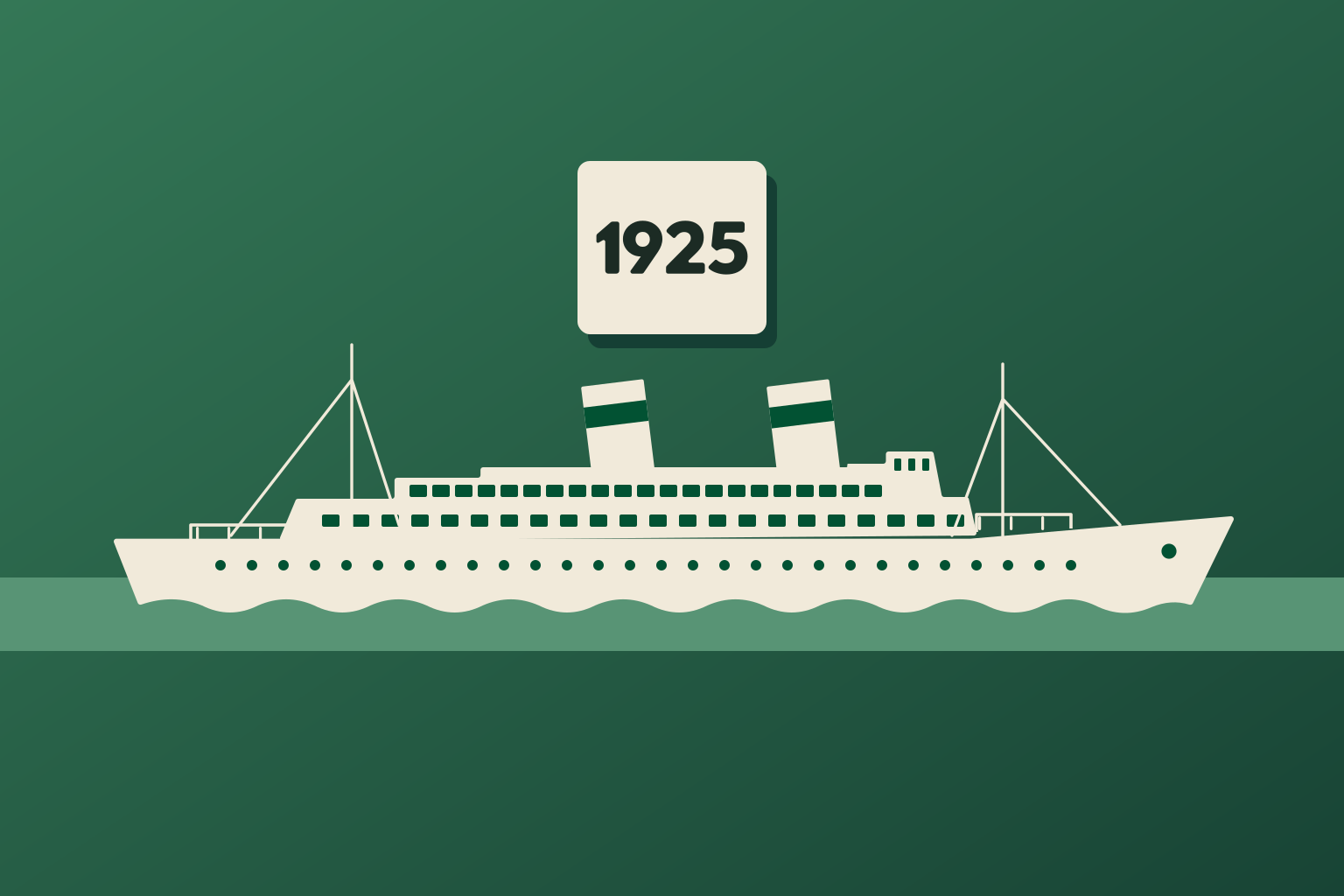
Bridge descends from whist, the English trick-taking game of the eighteenth century, by way of three intermediate games. Contract bridge, the form played today, dates from 1925, when Harold Vanderbilt settled its scoring on a steamship voyage through the Panama Canal.
Updated 14 October 2026
Whist was the card game of English drawing rooms and coffee houses long before anyone dealt a hand of bridge. Four players in two partnerships played thirteen tricks with a full pack, and the last card dealt fixed the trump suit. Every feature that bridge added later, from the dummy to the auction to the contract, was grafted onto that framework one change at a time, over roughly forty years.
From whist to bridge
Bridge grew out of whist, the trick-taking game played in England by the seventeenth century. Whist became a serious game in 1742, when Edmond Hoyle published A Short Treatise on the Game of Whist. It sold so well that "according to Hoyle" passed into the language as a phrase for doing anything by the rules. Through the eighteenth and nineteenth centuries whist was the standard partnership card game in Britain and America, with its own literature of leads and signals.
The earliest known printed description of something recognizably like bridge is a short pamphlet published in London in 1886, Biritch, or Russian Whist, usually attributed to John Collinson. Its game differed from whist in three ways that still define bridge. The dealer, or the dealer's partner if the dealer passed the choice across, named the trump suit or chose to play without trumps (the declaration called "biritch"). The declarer's partner laid the hand face up as a dummy, and declarer played both hands. And the opponents could double the stakes, with a redouble available in reply.
Nobody is sure where the name came from. "Biritch" is the usual account, and the pamphlet links the game to Russia, but later writers placed its early players in Constantinople, in the Levant and in Russia itself, and suggested origins from a Russian word for a herald to a Turkish phrase. The sources disagree, and no single explanation has been proved.
By the 1890s the game, now called bridge whist or simply bridge, had reached the London clubs. It was taken up at the Portland Club in 1894, and within a few years it had displaced whist in British and American club rooms. The appeal was easy to see. Choosing trumps instead of having them turned up gave the better player more to do, and the dummy made declarer play a game of planning that whist could not offer.
What was auction bridge?
Auction bridge was the version in which all four players bid against each other for the right to name trumps, and it replaced bridge whist after about 1904. Several people later claimed to have invented it, and the early history is thin, but 1904 is the date most references give for its first appearance.
The auction changed the game more than any rule before it. A bid now named a number of tricks and a suit, each bid had to outrank the last, and the highest bidder became declarer. What the auction did not yet do was tie the score to the bid. In auction bridge a side that bid one spade and made ten tricks scored every trick toward game, so there was little reason to bid higher than needed to win the auction. Auction bridge was the standard game through the 1910s and into the 1920s, and the first systems of bidding, such as Milton Work's, were written for it.
In France a variant called plafond ("ceiling") went a step further. Only the tricks a side had contracted for counted toward game, and anything more scored as a bonus. That idea was the seed of the modern game.
Who invented contract bridge?
Harold Stirling Vanderbilt, an American yachtsman and railroad heir, invented contract bridge in 1925 by writing the scoring table that is still the basis of the game. He took plafond's rule that only tricks bid for count toward game and built a scoring system around it, with large bonuses for bidding and making game and slam.
He worked the scheme out on board the SS Finland, a passenger liner on a cruise from California through the Panama Canal to Havana. The decisive sessions, by his own account, were played on the evening of October 31 and the morning of November 1, 1925, while the ship was at the Panama Canal. He also added vulnerability, a state reached by winning a game, which raises both the bonuses and the penalties for going down. A side that is vulnerable has more to win and more to lose, and that one idea still shapes every competitive decision in the auction.
Vanderbilt's friends in New York took the game up that winter, and it spread through the American clubs faster than any card game before it. By 1930 contract had replaced auction as the game most players meant by "bridge". Vanderbilt also donated the Vanderbilt Cup for a knockout teams championship, first played in 1928 and still contested at the ACBL's spring tournament. The rules of the game itself are covered in the laws of bridge, and how the play works today in how to play bridge.
Culbertson, Goren and the point count
Ely Culbertson made contract bridge a national craze in the United States. He founded the magazine The Bridge World in 1929, published his Contract Bridge Blue Book in 1930, and built a bidding system around honor tricks, a count of the high cards likely to win tricks in the first two rounds of a suit (an ace-king as two, an ace as one, a king-queen as one, and so on).
His biggest piece of publicity was a challenge match against Sidney Lenz, who stood for the rival "official system". The Culbertson-Lenz match ran from December 1931 into January 1932 over 150 rubbers, with Culbertson and his partners winning by a comfortable margin. Newspapers reported it hand by hand, and Culbertson's books and system dominated the following decade.
The count most players use today is older than Culbertson's. The 4-3-2-1 point count, four for an ace, three for a king, two for a queen and one for a jack, is known as the Work count after Milton Work, who promoted it in the auction bridge era. It became the standard only after Charles Goren combined it with points for distribution in Point Count Bidding in Contract Bridge (1949). Goren's books replaced Culbertson's as the American standard, and Goren was the face of the game in the 1950s and 1960s, with a syndicated newspaper column and a 1958 cover of Time. The method lives on in every beginner's first lesson, and its strengths and limits are covered in hand evaluation.
Duplicate, the ACBL and the Blue Team
The idea of replaying the same deals at different tables, to take the luck of the cards out of the result, came from whist. Duplicate whist was played in the second half of the nineteenth century, and John T. Mitchell's movement for it, still used in bridge clubs, dates from the early 1890s. Contract bridge inherited the method, and duplicate became the form of the game played in clubs and tournaments. How it runs today is explained in duplicate bridge.
In North America the American Contract Bridge League was formed in 1937 from the merger of two earlier bodies, the American Bridge League and the United States Bridge Association. It sanctions tournaments, awards masterpoints and publishes the laws for its members.
World championship play began after the Second World War. The Bermuda Bowl, the world teams championship, was first played in Bermuda in 1950, and the World Bridge Federation was founded in 1958. The great team of the period was Italy's Blue Team (the Squadra Azzurra), with players such as Giorgio Belladonna, Walter Avarelli, Pietro Forquet and Benito Garozzo. Italy won the Bermuda Bowl every time it was held from 1957 to 1969, ten titles in all, added three World Team Olympiads in 1964, 1968 and 1972, and won the Bermuda Bowl again in 1973, 1974 and 1975. No team has dominated the game for that long since.
Bidding systems and conventions
As the game matured, bidding split into national systems. In the United States, Goren's methods grew into Standard American, later codified by the ACBL as the Standard American Yellow Card. In Britain the Acol system took its name from the Acol Bridge Club on Acol Road in Hampstead, London, where it was developed in the 1930s by players including Maurice Harrison-Gray, Jack Marx and S. J. Simon. Acol plays a weak notrump and four-card majors and is still the usual system in British clubs.
Two later systems changed expert practice. Precision, a strong club system devised by C. C. Wei, came to attention when Taiwan's team using it reached the Bermuda Bowl final in 1969. Two over one game force, in which a new suit at the two level by an unpassed responder commits the partnership to game, spread through American tournament play in the 1980s and 1990s and is now the usual expert base system there. It has its own guide at two over one.
Alongside the systems came conventions, bids given an artificial meaning by agreement. Easley Blackwood devised his 4NT ace ask in 1933, and it remains the best known convention in the game (Blackwood). The 2♣ response to 1NT asking for a four-card major was published by Sam Stayman in The Bridge World in 1945. Stayman credited his partner George Rapée with the idea, and Britain's Jack Marx had found much the same bid a few years earlier, but the convention carries Stayman's name (Stayman). The list has grown ever since, and the conventions overview sorts the ones a club player meets.
Bridge today
Computers changed both how bridge is played and how it is studied. A double dummy solver looks at all four hands and finds the best result for both sides on every lead, in a fraction of a second, which settles arguments that used to run for pages in the magazines. Playing programs took longer. Matthew Ginsberg's GIB, from the late 1990s, was the first to play at a respectable level by sampling possible layouts of the unseen hands and solving each one double dummy. Its successors play a sound game today, and the robot partner is a normal way to practice.
Online play began in the 1990s and grew quickly once home internet connections were common. Today a player can find a game, a robot tournament or a teaching table at any hour, and many clubs run online sessions alongside their face-to-face games.
Bridge also gained a footing as a mind sport. The International Olympic Committee recognized the World Bridge Federation in 1995 and accepted it as a full international federation in 1999, but bridge has never been part of the Olympic program. It was played at the first World Mind Sports Games in Beijing in 2008 and was a medal event at the 2018 Asian Games in Jakarta and Palembang.
The players at the table have changed too. Club bridge in Europe and North America draws a membership that is mostly retired, and the national bodies run school and university programs to bring in younger players. The game itself, the scoring Vanderbilt wrote in 1925, has hardly changed at all. Bridge positions and the bridge terms glossary show the modern game as it is played, and bridge tournaments picks up where this page leaves off, at the events the game grew into.
Timeline of bridge history
| Year | Event |
|---|---|
| 1742 | Edmond Hoyle publishes A Short Treatise on the Game of Whist |
| 1886 | The pamphlet Biritch, or Russian Whist is published in London |
| 1894 | Bridge whist is taken up at the Portland Club in London |
| 1904 | Auction bridge appears and soon replaces bridge whist |
| 1925 | Harold Vanderbilt devises contract bridge on the SS Finland |
| 1928 | First Vanderbilt Cup knockout teams |
| 1929 | Ely Culbertson founds The Bridge World |
| 1931 to 1932 | The Culbertson-Lenz match, 150 rubbers |
| 1933 | Easley Blackwood devises the 4NT ace ask |
| 1937 | The American Contract Bridge League is formed |
| 1945 | Sam Stayman publishes the 2♣ response to 1NT |
| 1949 | Charles Goren's Point Count Bidding in Contract Bridge |
| 1950 | First Bermuda Bowl, played in Bermuda |
| 1958 | The World Bridge Federation is founded |
Common questions
Short answers to what readers ask most.
- Who invented bridge?
- No single person invented bridge, but Harold Vanderbilt invented contract bridge, the modern form, in 1925. The earlier stages, bridge whist and auction bridge, grew out of whist over the previous forty years without a clear inventor.
- When was bridge invented?
- Contract bridge dates from 1925. Its ancestors are older, with biritch, the forerunner of bridge whist, described in print in 1886 and auction bridge appearing around 1904.
- Why is it called bridge?
- Nobody knows for certain. The usual account derives it from "biritch", the name used in an 1886 London pamphlet, but the origin of that word is itself disputed and several theories have been offered.
- What is the difference between whist and bridge?
- In whist the trump suit is fixed by the last card dealt and every hand is played by its holder. Bridge adds an auction that decides the trump suit and the contract, and a dummy hand that declarer plays alongside their own.
- What was auction bridge?
- Auction bridge was the game played from about 1904 until contract took over around 1930. Players bid for the right to name trumps, but every trick won counted toward game, not only the tricks bid for.
- Is bridge an Olympic sport?
- No. The International Olympic Committee first recognized the World Bridge Federation in 1995 and gave it full recognition in 1999, but bridge has never been on the Olympic program. It has been played at the World Mind Sports Games and was a medal event at the 2018 Asian Games.
Practice: the history of bridge
Eight quick questions on what you just read. For a longer session, take the hundred-question quiz.