Bidding systems
Bridge Bidding Cheat Sheet
The bridge bidding cheat sheet gathers the main bids of a standard system on one page, from opening the auction to responding and bidding again. It follows Standard American, the same base as the Standard American Yellow Card, and gives you something to check during practice until the common auctions feel familiar. The whole sheet is also a free one-page PDF you can print and study between games.
Download the cheat sheet as a PDF
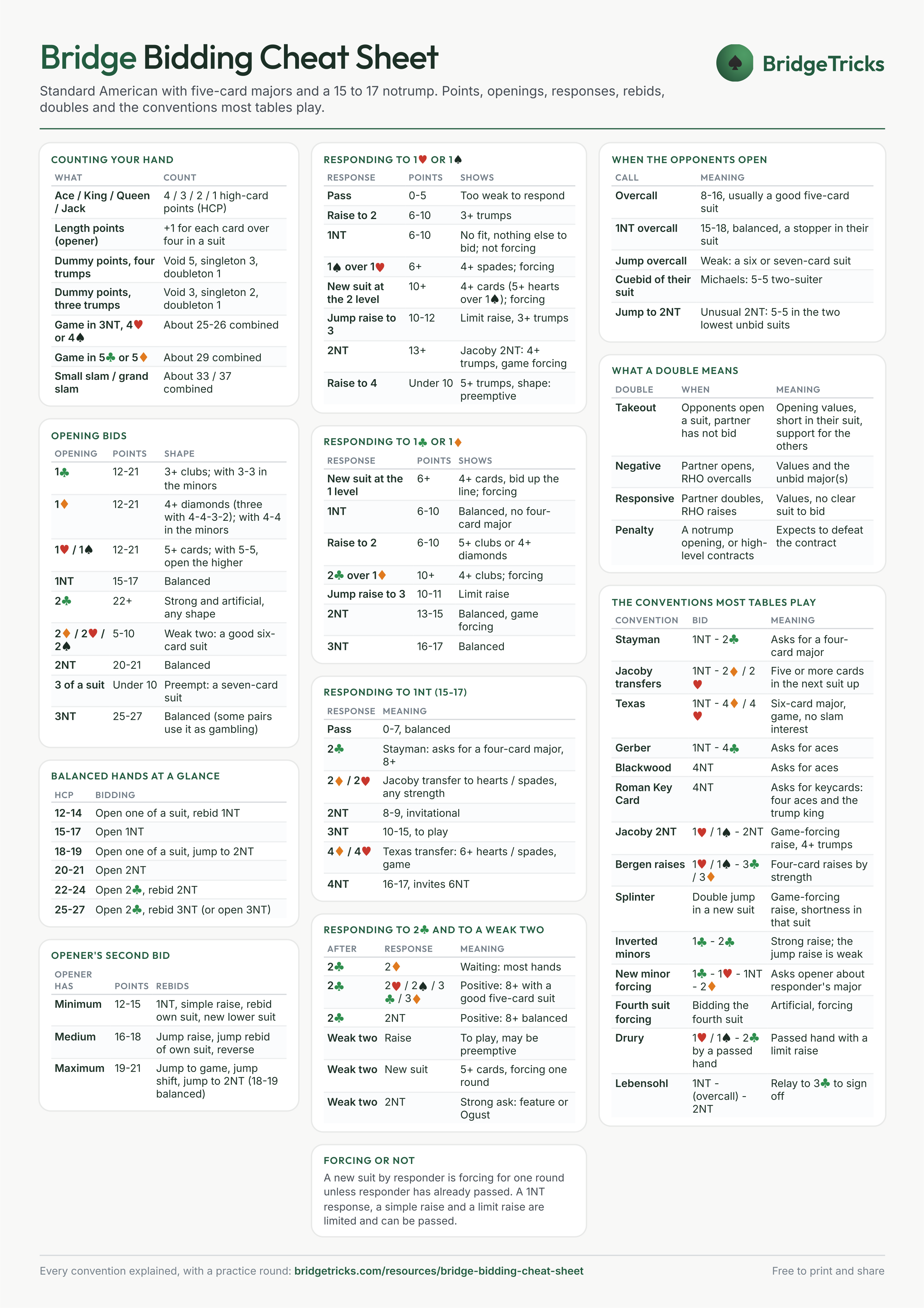
The whole cheat sheet on one page
Points, openings, responses, rebids, notrump ranges, doubles and the conventions most tables play. No sign-up.
Bridge bidding cheat sheet: points and openings
| What | Count |
|---|---|
| Ace / King / Queen / Jack | 4 / 3 / 2 / 1 high-card points (HCP) |
| Length points (opener) | +1 for each card over four in a suit |
| Dummy points, four trumps | Void 5, singleton 3, doubleton 1 |
| Dummy points, three trumps | Void 3, singleton 2, doubleton 1 |
| Game in 3NT, 4♥ or 4♠ | About 25-26 combined |
| Game in 5♣ or 5♦ | About 29 combined |
| Small slam / grand slam | About 33 / 37 combined |
Open the bidding with 12 or more HCP, or with 11 and a shapely hand that passes the rule of 20. The hand evaluation guide goes into counting in more detail.
| Opening | Points | Shape |
|---|---|---|
| 1♣ | 12-21 | 3+ clubs; with 3-3 in the minors |
| 1♦ | 12-21 | 4+ diamonds (three with 4-4-3-2); with 4-4 in the minors |
| 1♥ / 1♠ | 12-21 | 5+ cards; with 5-5, open the higher |
| 1NT | 15-17 | Balanced |
| 2♣ | 22+ | Strong and artificial, any shape |
| 2♦ / 2♥ / 2♠ | 5-10 | Weak two: a good six-card suit |
| 2NT | 20-21 | Balanced |
| 3 of a suit | Under 10 | Preempt: a seven-card suit |
| 3NT | 25-27 | Balanced (some pairs use it as gambling) |
Responses
| Response | Points | Shows |
|---|---|---|
| Pass | 0-5 | Too weak to respond |
| Raise to 2 | 6-10 | 3+ trumps |
| 1NT | 6-10 | No fit, nothing else to bid; not forcing |
| 1♠ over 1♥ | 6+ | 4+ spades; forcing |
| New suit at the 2 level | 10+ | 4+ cards (5+ hearts over 1♠); forcing |
| Jump raise to 3 | 10-12 | Limit raise, 3+ trumps |
| 2NT | 13+ | Jacoby 2NT: 4+ trumps, game forcing |
| Raise to 4 | Under 10 | 5+ trumps, shape: preemptive |
| Response | Points | Shows |
|---|---|---|
| New suit at the 1 level | 6+ | 4+ cards, bid up the line; forcing |
| 1NT | 6-10 | Balanced, no four-card major |
| Raise to 2 | 6-10 | 5+ clubs or 4+ diamonds |
| 2♣ over 1♦ | 10+ | 4+ clubs; forcing |
| Jump raise to 3 | 10-11 | Limit raise |
| 2NT | 13-15 | Balanced, game forcing |
| 3NT | 16-17 | Balanced |
| Response | Meaning |
|---|---|
| Pass | 0-7, balanced |
| 2♣ | Stayman: asks for a four-card major, 8+ |
| 2♦ / 2♥ | Jacoby transfer to hearts / spades, any strength |
| 2NT | 8-9, invitational |
| 3NT | 10-15, to play |
| 4♦ / 4♥ | Texas transfer: 6+ hearts / spades, game |
| 4NT | 16-17, invites 6NT |
Opener's rebids and notrump ranges
| Opener has | Points | Rebids |
|---|---|---|
| Minimum | 12-15 | 1NT, simple raise, rebid own suit, new lower suit |
| Medium | 16-18 | Jump raise, jump rebid of own suit, reverse |
| Maximum | 19-21 | Jump to game, jump shift, jump to 2NT (18-19 balanced) |
| HCP | Bidding |
|---|---|
| 12-14 | Open one of a suit, rebid 1NT |
| 15-17 | Open 1NT |
| 18-19 | Open one of a suit, jump to 2NT |
| 20-21 | Open 2NT |
| 22-24 | Open 2♣, rebid 2NT |
| 25-27 | Open 2♣, rebid 3NT (or open 3NT) |
Overcalls and doubles
| Call | Meaning |
|---|---|
| Overcall | 8-16, usually a good five-card suit |
| 1NT overcall | 15-18, balanced, a stopper in their suit |
| Jump overcall | Weak: a six or seven-card suit |
| Cuebid of their suit | Michaels: 5-5 two-suiter |
| Jump to 2NT | Unusual 2NT: 5-5 in the two lowest unbid suits |
| Double | When | Meaning |
|---|---|---|
| Takeout | Opponents open a suit, partner has not bid | Opening values, short in their suit, support for the others |
| Negative | Partner opens, RHO overcalls | Values and the unbid major(s) |
| Responsive | Partner doubles, RHO raises | Values, no clear suit to bid |
| Penalty | A notrump opening, or high-level contracts | Expects to defeat the contract |
Common conventions in one line
| Convention | Bid | Meaning |
|---|---|---|
| Stayman | 1NT - 2♣ | Asks for a four-card major |
| Jacoby transfers | 1NT - 2♦ / 2♥ | Five or more cards in the next suit up |
| Texas | 1NT - 4♦ / 4♥ | Six-card major, game, no slam interest |
| Gerber | 1NT - 4♣ | Asks for aces |
| Blackwood | 4NT | Asks for aces |
| Roman Key Card | 4NT | Asks for keycards: four aces and the trump king |
| Jacoby 2NT | 1♥ / 1♠ - 2NT | Game-forcing raise, 4+ trumps |
| Bergen raises | 1♥ / 1♠ - 3♣ / 3♦ | Four-card raises by strength |
| Splinter | Double jump in a new suit | Game-forcing raise, shortness in that suit |
| Inverted minors | 1♣ - 2♣ | Strong raise, forcing one round; the jump raise is weak |
| New minor forcing | 1♣ - 1♥ - 1NT - 2♦ | Asks opener about responder's major |
| Fourth suit forcing | Bidding the fourth suit | Artificial, forcing |
| Drury | 1♥ / 1♠ - 2♣ by a passed hand | Passed hand with a limit raise |
| Lebensohl | 1NT - (overcall) - 2NT | Relay to 3♣ to sign off |
Every convention on this sheet has its own guide with examples.
Common questions
Short answers to what readers ask most.
- How many points do you need to open in bridge?
- Usually 12 high-card points, or 11 with a shapely hand. A 1NT opening needs 15 to 17 in Standard American.
- How many points do you need for game?
- About 25 or 26 combined points for 3NT, 4♥ or 4♠, and about 29 for five of a minor.
- Which convention should I learn first?
- Stayman, closely followed by Jacoby transfers. You will use them on many hands after partner opens 1NT.
- Is a new suit response forcing?
- Yes. A new suit by an unpassed responder is forcing for one round. In two over one game force, a two-level new suit forces to game.
- Is this cheat sheet Standard American or Goren?
- It is Standard American with five-card majors, a 15 to 17 point 1NT, strong 2♣ and weak twos, and it matches the SAYC card closely. Goren's older style opened four-card majors and used a 16 to 18 1NT, though the high-card point count on this sheet is the one Goren made popular.
- Is there a PDF of this bridge bidding cheat sheet?
- Yes. The download at the top of the page is the same tables on one printed page, in A4 and US Letter, free and with no sign-up. It is built from the same tables you see here.
Practice: bidding basics
Eight quick questions on what you just read. For a longer session, bid a hundred hands or take the hundred-question quiz.