 Bidding systems
Bridge Bidding Systems
Two strangers can sit down at a club and bid together within a minute, as long as they learned the same methods. Most countries have a standard way of bidding that clubs teach and casual partners fall back on, and serious pairs build their own versions on top of it. For most players, sharing a system with partner and knowing it well counts for more than which system it is.
Which bridge bidding system should you learn?
Learn whatever your partners and your local club play. If you have no partner yet, follow the standard of the place where you will play most:
- North America: start with SAYC, the ACBL's Standard American Yellow Card, and move to 2/1 game force once you have a regular partner. The two share most of their bids, so the second step is small.
- Britain: learn Acol, the system the English Bridge Union teaches, with four-card majors and a weak 1NT.
- France: learn the SEF, the French federation's teaching standard, a five-card major system.
- Poland: learn Polish Club (Wspólny Język), a system built around a 1♣ opening with several meanings.
- Elsewhere: ask the local club or federation which standard it teaches. Many are close cousins of SAYC or 2/1, with five-card majors and a strong 1NT.
Strong club systems such as Precision are a good second system for a regular partnership, but few teachers start beginners with one. Nobody agrees on a best system. Teachers and experts argue about it, and world titles have been won with both natural and strong club methods.
The main systems at a glance
| System | Opening style | Majors | 1NT | Mainly played | Suits |
|---|---|---|---|---|---|
| SAYC | Natural | Five cards | 15-17 | North America (ACBL) | Beginners and casual partners |
| 2/1 game force | Natural | Five cards | 15-17 | North America, club and tournament pairs | Regular partners |
| Acol | Natural | Four cards | 12-14 | Britain (EBU) | British clubs, beginners |
| Precision | Strong club: 1♣ is 16+ | Five cards | 13-15 or 14-16 | Regular tournament pairs worldwide | Partners who practice together |
| Polish Club | 1♣ with three meanings | Five cards | 15-17 | Poland | Polish clubs, regular partners |
| SEF | Natural | Five cards | 15-17 | France (FFB) | French clubs, beginners |
In a natural system an opening bid of a suit shows length in that suit. In a strong club system 1♣ is artificial and shows a strong hand, which lets every other one-level opening promise a limited one. Polish Club sits between the two. Its 1♣ can be a minimum balanced hand, a strong hand or, in between, a hand with long clubs.
Natural systems: SAYC, 2/1 and Acol
SAYC
The Standard American Yellow Card is the system the ACBL published so that players who had never met could agree on a full card in seconds. It opens 1♥ and 1♠ only with five or more cards, 1NT with a balanced 15 to 17, uses the strong 2♣ as its only forcing opening and plays weak two bids. The conventions are a short list of well-known ones: Stayman, Jacoby transfers, Blackwood and a few more. Our SAYC guide goes through every opening and response.
2/1 game force
Two over one starts from the same openings as SAYC and changes one response. When partner opens one of a suit and you answer with a new suit at the two level, without jumping and before you have passed, the partnership is committed to game. Over a major, the 1NT response becomes forcing for one round and takes the weaker hands. Because game is settled early, both players can bid slowly and describe their hands without fear that partner will pass below game. Many North American tournament players use it. See the 2/1 guide for the forcing 1NT and opener's rebids.
Acol
Acol is named after the Acol Bridge Club in London, where it took shape in the early 1930s. It is a four-card major system: 1♥ or 1♠ can be opened on a four-card suit. Most Acol players use a weak 1NT of 12 to 14, so a balanced hand of 15 or more opens a suit and rebids notrump. Our Acol guide covers the openings, responses and rebids in full.
Acol's two-level openings have changed over time. Classic Acol played strong twos, showing about eight playing tricks and a long suit. The EBU introduced Standard English Acol in 1996 as a teaching standard, and its recommended methods have since moved to three weak twos (2♦, 2♥ and 2♠), leaving 2♣ as the only strong opening. Benjamin Acol, a variant, keeps 2♣ and 2♦ for strong hands and plays only 2♥ and 2♠ as weak.
Strong club systems: Precision and Polish Club
Precision
Precision was devised by C. C. Wei, who also promoted it. Taiwan's team played it to second place in the 1969 Bermuda Bowl, and Italy's Blue Team used a version of it in the early 1970s. Its opening 1♣ shows 16 or more points with any shape and says nothing about clubs. Partner answers 1♦ with a weak hand, usually under 8 points. The Precision guide goes through the responses and the other openings.
Every other opening is then limited to about 11 to 15. 1♥ and 1♠ show five cards, 2♣ shows a long club suit, and 1♦ is the catch-all for other hands in that range, sometimes with only two diamonds. The classic 1NT is 13 to 15, and many modern pairs play 14 to 16 instead. Partner knows the strength of most openings at once. In exchange the partnership needs many more agreements after 1♣, and the opponents like to jump in over it.
Polish Club
Polish Club, known in Poland as Wspólny Język ("common language"), uses 1♣ for three kinds of hand. In the 2005 version described by Krzysztof Jassem and published on the Polish federation's site, 1♣ shows either 12 to 14 points with no five-card major and no four diamonds, nearly always balanced, or 15 to 17 with five or more clubs in an unbalanced hand, or any hand of 18 or more. The other one-level suit openings show 12 to 17, with four or more diamonds for 1♦ and five cards for 1♥ or 1♠. Opener's second bid tells partner which kind of 1♣ it was.
How often each system's key hands come up
A system is built around the hands its openings describe best, and those hands do not come up equally often. These are the exact chances of being dealt each one, computed from every possible bridge hand. Balanced means 4-3-3-3, 4-4-3-2 or 5-3-3-2, and points are high-card points.
| Hand | Opening it suits | Chance | About one hand in |
|---|---|---|---|
| Balanced, 12 to 14 | Weak 1NT (Acol) | 9.68% | 10 |
| Balanced, 13 to 15 | Classic Precision 1NT | 8.04% | 12 |
| Balanced, 14 to 16 | Modern Precision 1NT | 6.40% | 16 |
| Balanced, 15 to 17 | Strong 1NT (SAYC, 2/1, SEF, Polish Club) | 4.87% | 21 |
| Any shape, 16 or more | Precision 1♣ | 9.76% | 10 |
| Any shape, 18 or more | Strong Polish 1♣ | 4.09% | 24 |
| Any shape, 22 or more | Strong 2♣ (SAYC, 2/1) | 0.42% | 236 |
A weak notrump comes up about twice as often as a strong one, because hands get rarer as the point count rises. An Acol pair opens 1NT on about one hand in ten and a SAYC pair on about one in twenty. That is one reason Acol players like it: 1NT is a hard opening to compete against, and the weak version puts it in play more often. The cost is that it goes down doubled more often too, when the opponents hold the balance of the points.
Precision's strong 1♣ turns up on about one hand in ten, roughly as often as a weak notrump, while the strong 2♣ of a natural system is rare. A hand of 16 or more is about 23 times as common as one of 22 or more. A Precision partnership therefore spends much of its practice on 1♣ auctions, and a natural partnership can learn its 2♣ structure once and seldom use it.
Systems also differ in how long a major must be to open it. Among hands of 12 to 21 points, a rough stand-in for an opening bid, this is how often each length of major turns up.
Four- and five-card major systems treat the hands in the middle row differently. An Acol player can open them in the major, while SAYC, 2/1 and the SEF open them in a minor or in 1NT and find the major fit later.
The differences players ask about
Four-card or five-card majors
A five-card major opening promises five, so partner can raise with three trumps and the partnership knows of an eight-card fit at once. A four-card major gets the suit in early on more hands but makes raises less sure, so Acol players usually want four trumps to raise, or take more care finding the fit.
Weak or strong notrump
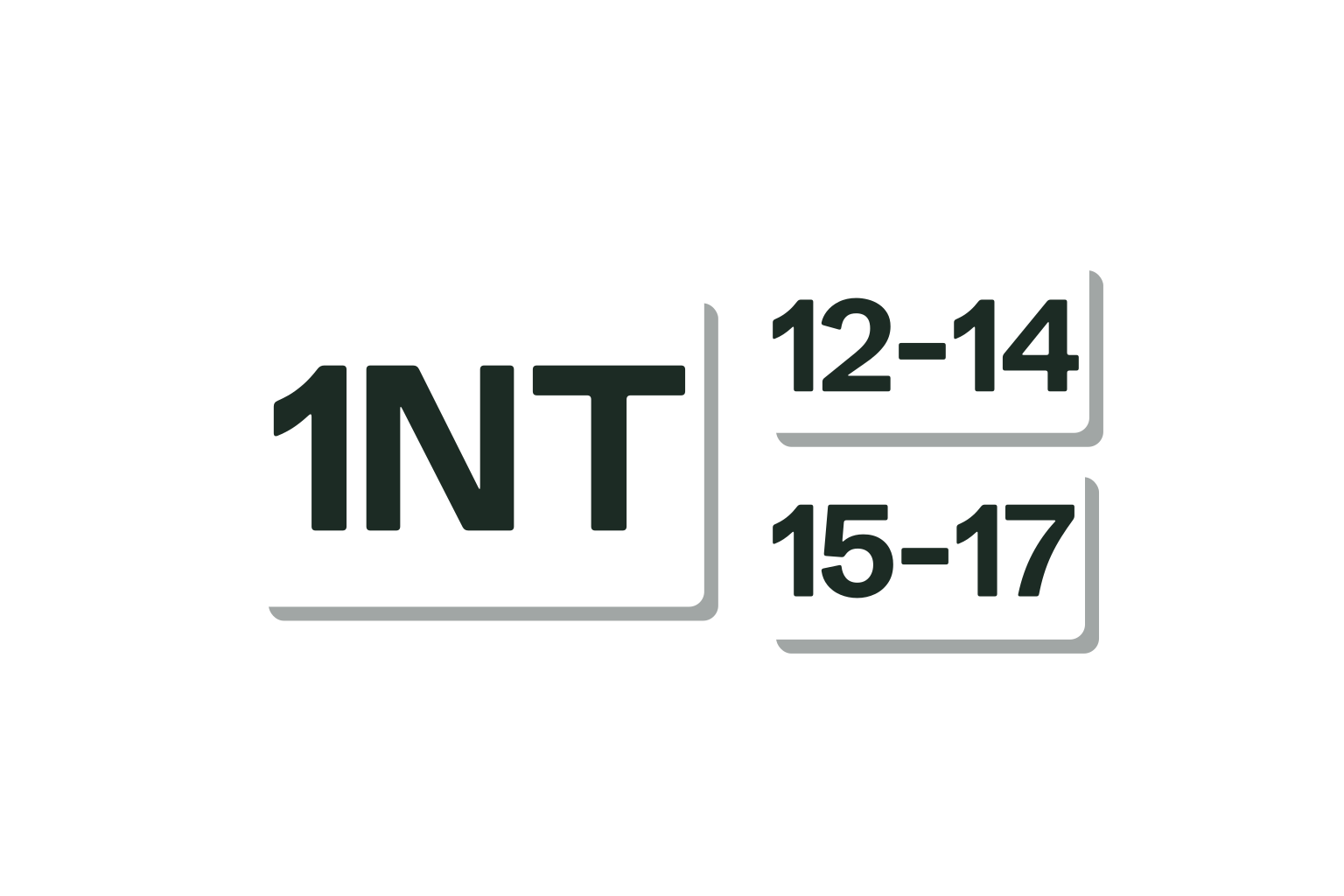
A 12 to 14 1NT comes up more often and takes away the opponents' one-level bids. A 15 to 17 1NT is safer and helps partner judge game more easily. Over either one, partner uses the same tools, Stayman and transfers, with the point counts moved to match.
Natural or strong club
In a natural system your first bid shows a suit, and strength comes out on the second round. In a strong club system your first bid shows strength, and the suits come out later. Strong club methods are accurate in uncontested auctions, but they need more memory and more partnership practice, which is why most clubs teach a natural system first.
What "game forcing" changes in 2/1
In SAYC, 1♠ - 2♣ shows about 10 or more points and forces only one round, so both players may have to jump later to show extra values. In 2/1, the same response promises an opening hand and commits to game, so nobody needs to jump. Weaker hands that would bid a new suit at the two level in SAYC go through the forcing 1NT first instead.
Standard systems in Italy, France, the Netherlands and Poland
France. The French federation (FFB) publishes the SEF, the Système d'Enseignement Français. The first edition came out in 1987, and new ones followed in 1993, 2006, 2012 and 2018. The federation now revises it every six years, and the latest edition is from 2024. It plays five-card majors, a 15 to 17 1NT that recent editions allow with a five-card major, a strong 2♣, a game-forcing 2♦ and weak twos in the majors. French players can sit down and say "SEF" and expect to understand each other.
Poland. Polish Club, in the Wspólny Język versions, is widely played at Polish clubs, and the Polish federation (PZBS) hosts the system's description on its site.
The Netherlands. The Dutch federation (NBB) teaches beginners through its course Start met bridge, which uses the federation's own Standaard Hoog system, built on five-card majors (vijfkaart hoog). A 2021 article in the Dutch magazine IMP notes that Standaard Hoog has no official status as a national standard and leaves many later auctions undescribed.
Italy. Writers in the federation's magazine describe natural five-card major methods, called Quinta Nobile, as the usual choice in Italian clubs today. The federation (FIGB) has published a five-card major standard built on its teaching text, the Quinta Italiana of 2011, with a 15 to 17 1NT. The older Standard Italia used 16 to 18, so check the range with a new partner.
How to choose a system and learn it
Four things decide it, roughly in this order:
- 1.Your partners. You both need to know the system well, so a simple one you both remember works better than a complex one you half remember.
- 2.Your club. Playing what the room plays means fewer surprises from the opponents, and easier pickup partners on nights your regular one is away.
- 3.Where you compete. Tournaments allow most mainstream systems, but some events limit artificial methods, so check the rules before you take a strong club system to a new event.
- 4.How much you want to remember. SAYC and Acol fit on one card. 2/1 adds a few agreements, and a strong club system adds many more.
Once you have chosen, learn the openings and the first responses before any conventions. The bridge bidding cheat sheet puts the SAYC basics on one page and is a fair base for any five-card major system. Then sit down with your partner and fill in a convention card together: it shows the gaps in your agreements before they cost a board, and the opponents are entitled to see it at a duplicate event. Add one convention at a time, and only when a real hand has shown you need it. Our bidding guide covers the principles every system shares.
Common questions
Short answers to what readers ask most.
- What is the most popular bridge bidding system?
- There is no reliable worldwide count. Each federation teaches its own standard: SAYC and 2/1 in North America, Acol in Britain, the SEF in France, Polish Club in Poland. SAYC, 2/1 and the SEF are natural systems with five-card majors and a 15 to 17 1NT. Polish Club shares both features but opens an artificial 1♣.
- What is the easiest bridge bidding system?
- SAYC and Acol are the usual choices for beginners, because both are natural and fit on one convention card. Pick the one played where you live, since you will learn faster with partners who play it too.
- What is the difference between SAYC and 2 over 1?
- They share most openings, including five-card majors and a 15 to 17 1NT. In 2/1 a new-suit response at the two level by an unpassed hand forces to game, and over a major the 1NT response becomes forcing for one round. In SAYC that two-level response forces only one round and 1NT is not forcing.
- Which bidding system should a beginner learn?
- The one your club and your partners play. In North America that usually means SAYC, then 2/1 later. In Britain it means Acol, and in France the SEF.
- Is Precision better than 2/1?
- Neither is better for every pair. Precision limits most openings at once and helps in uncontested auctions, but it needs more memory and practice, and the opponents often jump in over its 1♣. 2/1 is easier to learn and to play with occasional partners.
- What bridge bidding system has four letters?
- Acol, the British system with four-card majors and a weak 1NT, is the usual crossword answer. SAYC also has four letters, as the abbreviation of Standard American Yellow Card.
Practice: bridge bidding systems
Eight quick questions on what you just read. For a longer session, take the hundred-question quiz.