Learn bridge
The Revoke
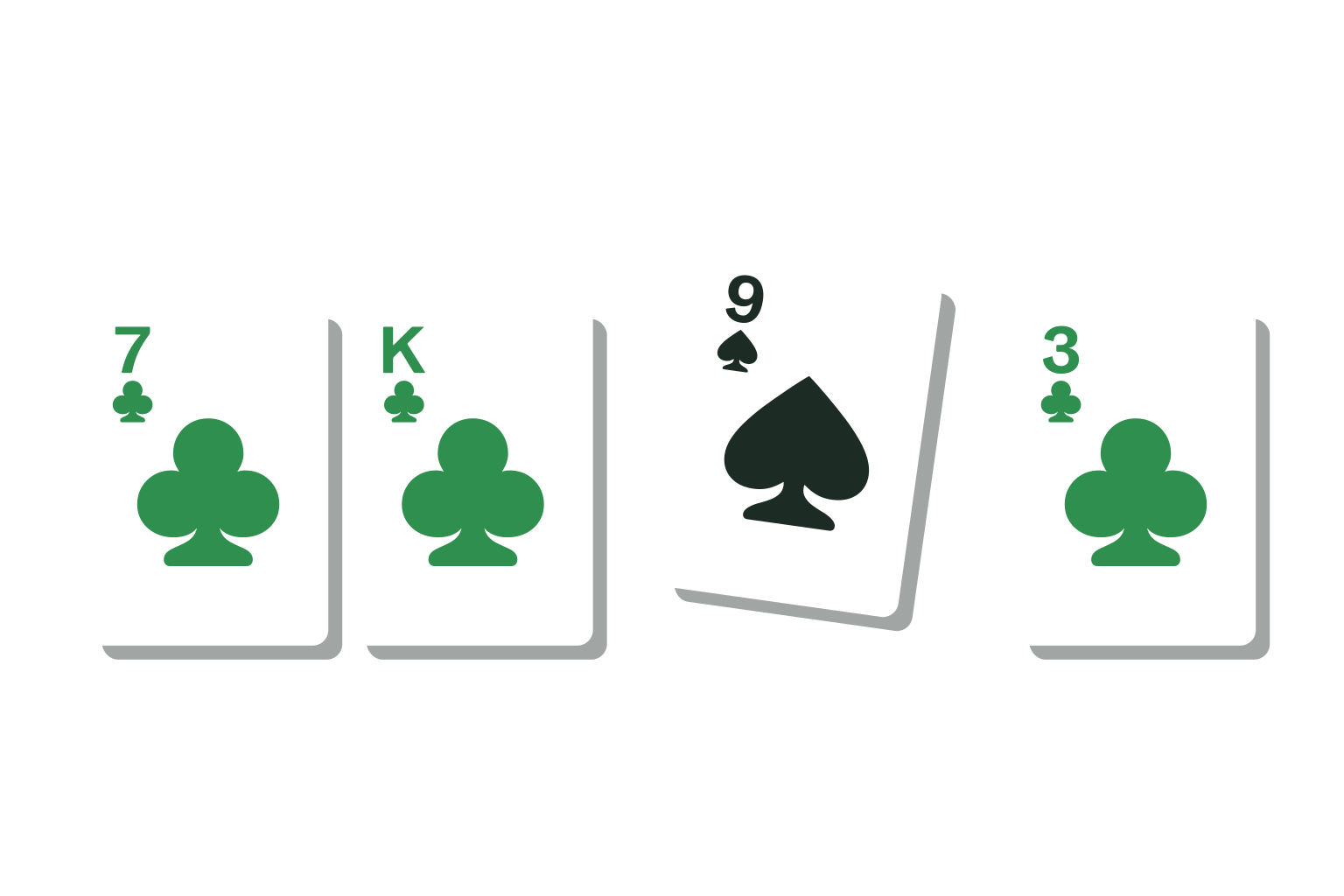
Every player has to follow suit when they can, and sooner or later everyone gets it wrong, often because a card was sorted into the wrong suit. The laws treat this as an accident to put right. A slip caught before play moves on costs little to correct, and one found later usually gives tricks to the other side to make up for it.
What is a revoke in bridge?
Law 44 of the Laws of Duplicate Bridge says that in playing to a trick each player must follow suit if possible, and it ranks this duty above every other requirement in the laws. Only a player with no card of the suit led may play anything else, either a discard from another suit or a ruff with a trump (the bridge terms glossary explains both).
A revoke (Law 61A) is a failure to follow suit when you could have. The same word covers a second case that beginners rarely meet. If the laws or an opponent require you to play a particular card or suit after an irregularity, for example a penalty card you must play, and you fail to do it when able, that is a revoke too.
Renege means the same thing. It is an informal word, heard at rubber bridge and social tables, and many players know it from whist and other trick-taking games. The laws only say revoke. The basic rules of the play are on the rules of bridge, and how to play bridge walks a beginner through a whole deal.
Showing out is not a revoke. A player who really has no card of the suit is free to discard or ruff, and the other three learn something useful from it. It is a revoke only when the player still has a card of that suit, usually hidden behind another card or sorted with the wrong suit.
Asking "having none?"
The laws let players check a possible revoke before it does any harm. Law 61B sets out who may ask whom when a player fails to follow suit.
- Declarer may ask a defender who has shown out whether they have a card of the suit led.
- Dummy may ask declarer, and this is one of the few things dummy may say during the play (Law 42B1). Dummy may not ask a defender.
- The defenders may ask declarer and may ask each other, at the risk of passing information to partner.
The usual words are "having none?" or "no hearts, partner?". If dummy has broken the limits of Law 43, for example by looking at a defender's cards, and is the first to ask, declarer must still correct the revoke, but the trick adjustment then applies as if it had been established (Law 43B2b).
A defender who asks partner only when something looks wrong may be telling partner more than the question itself. Many defenders ask every time partner shows out, so the question carries no message. The habit takes a few seconds and lets a revoke be put right before it is established.
Correcting a revoke before it is established
A revoke that is noticed in time must be corrected (Law 62A). The player takes back the wrong card and plays a legal one, a card of the suit led. What happens to the card taken back depends on who played it.
| Who revoked | The withdrawn card |
|---|---|
| A defender, from the hand | Becomes a major penalty card, left face up on the table |
| Declarer, from the hand | Goes back into the hand with no further penalty |
| Dummy | Goes back into dummy with no further penalty |
| A defender, with a card already face up (such as a penalty card) | Is replaced with no further penalty |
For a defender the withdrawn card is always a major penalty card, even a small one. Law 50B makes a single small card dropped by accident a minor penalty card, but a card exposed through deliberate play is a major one, and the law gives revoking and then correcting as an example. A major penalty card must be played at the first legal chance, and when the offender's partner next gets the lead declarer may require or forbid a lead of that suit. The duty to follow suit still comes first, so the card waits on the table until it can be played legally.
The other cards played to the trick can change too (Law 62C). The side that did not revoke may take back any card it played after the revoke and play a different one. The revoking side may not make use of what it learns from those cards (Law 16C).
The laws make one exception to the general rule that you need not point out your own side's mistakes. A revoke you notice yourself before it is established must be corrected (Laws 62A and 72B2), and trying to hide it, for example by revoking again in the same suit, is a breach of Law 72B3.
When does a revoke become established?
Law 63A lists the moments after which a revoke can no longer be corrected. It becomes established as soon as any of these happens.
- 1.The player who revoked, or their partner, leads or plays to the next trick. Any play counts, legal or not.
- 2.The player who revoked, or their partner, names or otherwise chooses a card for the next trick.
- 3.A member of the revoking side makes a claim or concession of tricks, by speaking, by facing their hand or in any other way.
- 4.The revoking side accepts an opponent's claim or concession and raises no objection before the end of the round or before making a call on the next board.
Plays by the other side do not establish the revoke. If a defender revokes, declarer wins the trick and leads to the next one, the revoke can still be corrected until the defender or partner plays to that trick. Once established, the revoke trick stands as played (Law 63B) and play continues normally. Any trick adjustment is made only after the last trick.
How many tricks does a revoke cost?
The 2017 Laws call it an automatic trick adjustment rather than a penalty, and Law 64A sets it out in two cases. The number of tricks depends on who won the trick on which the revoke happened, and on whether the revoking side won any trick from then on.
- 1.If the player who revoked won the revoke trick, that trick goes to the other side at the end of play, plus one more trick if the revoking side won any later trick.
- 2.If the player who revoked did not win the revoke trick, one trick goes to the other side, provided the revoking side won the revoke trick or any later trick.
| Revoke trick won by | Revoking side wins a later trick? | Tricks transferred |
|---|---|---|
| The player who revoked | Yes | Two |
| The player who revoked | No | One |
| The revoker's partner (or dummy, if declarer revoked) | Yes or no | One |
| The other side | Yes | One |
| The other side | No | None |
Tricks the revoking side won before the revoke never count. A trick won in dummy does not count as won by declarer for this law (a footnote to Law 64A), so when declarer revokes and dummy takes the trick, the most that can move is one trick. Transferred tricks are scored as if they had been won in play, so they can turn a failing contract into a made one, or a made contract into a failing one.
Example 1: one trick transferred
South plays 4♠, nobody vulnerable. The table shows who won each trick.
| Trick | What happened | Won by |
|---|---|---|
| 1 and 2 | West cashes the ♦A and ♦K | East-West |
| 3 to 5 | Declarer wins a club switch and draws trumps | North-South |
| 6 | Declarer leads a heart to dummy's ♥A. East, who still holds the ♥4, discards a club. | North-South (dummy) |
| 7 | Dummy leads and East plays a card, which establishes the revoke | North-South |
| 8 | Declarer runs a winner | North-South |
| 9 | East-West take a club | East-West |
| 10 and 11 | Declarer wins two more tricks | North-South |
| 12 | East-West take a heart | East-West |
| 13 | Declarer wins the last trick | North-South |
At the end of play South has nine tricks and East-West have four. East did not win trick 6, but East-West won tricks 9 and 12 after the revoke, so one trick is transferred. Tricks 1 and 2 do not matter because they came before the revoke. South finishes with ten tricks and 4♠ is made for +420 instead of one down for -50.
Example 2: two tricks transferred
South plays 4♠ again, nobody vulnerable, and this time a defender wins the revoke trick by ruffing.
| Trick | What happened | Won by |
|---|---|---|
| 1 and 2 | West leads the ♥A and continues with the ♥K | East-West |
| 3 to 6 | Declarer wins all four | North-South |
| 7 | Declarer leads the ♣K. East, who still holds the ♣5, ruffs with the ♠7 and wins. | East-West (East) |
| 8 | East leads a diamond, which establishes the revoke | North-South |
| 9 and 10 | Declarer wins both | North-South |
| 11 | East-West take a diamond | East-West |
| 12 and 13 | Declarer wins both | North-South |
South has nine tricks and East-West have four. East won the revoke trick, so trick 7 goes to North-South, and because East-West also won trick 11 after it, one more trick goes with it. South finishes with eleven tricks and scores +450 for 4♠ with an overtrick. If East-West had taken no trick after trick 7, only trick 7 itself would move.
The adjustment is the same whether or not the revoke gained anything. In example 1 the revoke may have cost declarer nothing at all, and South still gets the extra trick.
When there is no trick adjustment
Law 64B lists the cases in which an established revoke moves no tricks automatically. The director can still restore equity in every one of them (see the next section).
- The revoking side won neither the revoke trick nor any later trick.
- It is a second revoke in the same suit by the same player, after the first one was established.
- The revoke was a failure to play a penalty card, or a card from dummy. Dummy is face up, so everyone could have seen it.
- Attention was first drawn to the revoke after a member of the other side made a call on the next deal, or after the round ended.
- It happened on the twelfth trick.
- Both sides revoked on the same board and both revokes were established.
- Both sides revoked on the same trick and both revokes were corrected under Law 62C3.
The twelfth trick has a rule of its own (Law 62D). A revoke there must be corrected even if it is established, as long as it is found before all four hands go back into the board, and no trick moves. If a defender revokes on trick twelve before partner has played, partner may not use what the wrong card showed.
The director restores equity (Law 64C)
The automatic adjustment is a rough rule, and sometimes the revoke gains more than one or two tricks. Law 64C1 tells the director to assign an adjusted score whenever the other side is not fully compensated for the damage, after any established revoke, including those with no automatic transfer.
Say declarer would have made ten tricks without the revoke. The revoke let the defenders keep a trump trick and gain a ruff, and declarer ended with eight tricks. One transferred trick gives only nine, so the director instead gives declarer the ten tricks that would most likely have been made without the revoke.
The director also adjusts after repeated revokes in one suit and when both sides revoked on the same board (Law 64C2). In a club game the players do not work any of this out themselves. Call the director as soon as anyone notices a revoke, and the director applies the law. Duplicate bridge explains the director's role.
Rubber bridge and home games
Rubber bridge has its own code of laws, separate from the duplicate laws. Its revoke rules follow the same outline of correction, establishment and a transfer of tricks, but the details are not identical, and older codes were harsher, which is why some players still say a revoke always costs two tricks. There is no director at a home table, so the four players apply the rules together. Many friendly games simply let a revoke that is noticed at once be taken back.
How to avoid revoking
Almost every revoke comes from a card in the wrong place or a moment of not looking. A few habits prevent most of them.
- Sort your hand with the colors alternating, black, red, black, red, so a stray club among the spades or a diamond among the hearts stands out.
- Count the cards in your hand before the opening lead and make sure you have thirteen. A card stuck behind another is easy to miss.
- Count the suit as it is played. If you started with four hearts and three have gone, you know you still hold one.
- Look again before you discard or ruff. Fan the whole hand and check the suit led one more time.
- Keep your played cards in order in front of you, as Law 65 asks, so a claimed revoke can be checked at the end of play.
- Ask "having none?" every time partner shows out, and as dummy every time declarer does.
Common questions
Short answers to what readers ask most.
- What happens if you do not follow suit in bridge?
- Failing to follow suit when you could have is a revoke. If it is noticed before your side plays to the next trick it is corrected, and a defender's wrong card becomes a penalty card. Once established it usually costs one or two tricks at the end of play.
- What is a renege in bridge?
- Renege is another word for a revoke, playing a card of a different suit when you could have followed suit. It is the informal term, common at rubber bridge and other card games, while the laws only use revoke.
- What is the penalty for a revoke in bridge?
- Under the 2017 Laws, one trick goes to the other side if the revoking side won the revoke trick or any later trick. Two tricks go if the player who revoked won the revoke trick and the side won another trick later. The director can award more if the damage was greater.
- When is a revoke established?
- A revoke becomes established when the player who revoked, or their partner, leads or plays to the next trick, names a card for it, or makes or agrees to a claim or concession. Until then it must be corrected.
- Can dummy point out a revoke?
- Dummy may ask declarer "having none?" when declarer shows out, but may not ask a defender. Dummy may draw attention to a defender's revoke only after the play of the hand is over.
- Is there a revoke penalty on the last tricks?
- A revoke on the twelfth trick must be corrected even if it is established, and no trick is transferred. Each player has only one card left at trick thirteen, so there is nothing to revoke with.
Practice: the revoke
Eight quick questions on what you just read. For a longer session, take the hundred-question quiz.